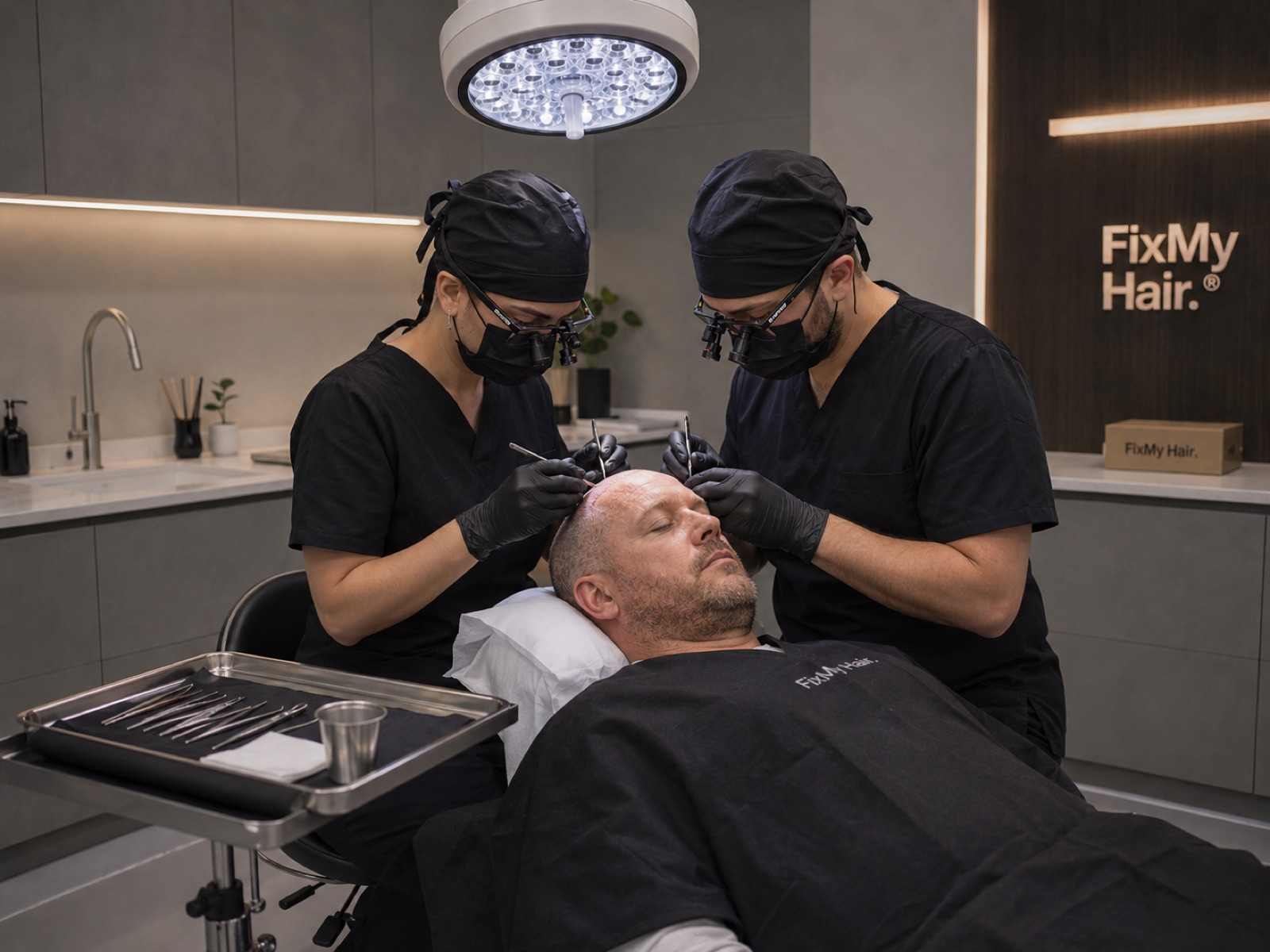
FUE vs FUT vs DHI — Which Is Right for You?
 Written by the Fix My Hair Editorial Team · Clinician-reviewed by Dr Hisham Band · GMC No. 7550130 · Last reviewed 20 Jan 2026
Every clinic has a favourite technique. Understanding the differences — and when each genuinely makes sense — is how you make an informed decision rather than a marketed one.
FUE — the modern standard
Follicular Unit Excision removes grafts individually, leaving no linear scar and allowing a shorter, more comfortable recovery. Sapphire FUE uses a sapphire blade to cut finer channels with less trauma.
FUT — when you need volume
FUT removes a strip of donor skin, yielding more grafts in one session. The trade-off is a fine linear scar, easily hidden by surrounding hair.
DHI — density and definition
DHI uses an implanter pen to place grafts directly, allowing dense packing and precise angles — excellent for hairlines. Ultimately, surgeon skill matters more than the acronym. See how we approach Sapphire FUE.
The three techniques, side by side
- FUE (Follicular Unit Excision) — grafts removed one by one. No linear scar, faster recovery, donor area healed within days. Suits most patients and anyone who wears their hair short.
- FUT (Follicular Unit Transplantation) — a strip of donor skin is removed and dissected into grafts. Yields the most grafts in a single session, but leaves a fine linear scar. Best for very large cases.
- DHI (Direct Hair Implantation) — a variant of FUE where grafts are placed with an implanter pen rather than pre-made incisions. Allows dense, precise placement — ideal for hairlines and detail work.
How they differ on the things that matter
Scarring. FUE and DHI leave tiny dot scars scattered across the donor area, invisible at normal hair length. FUT leaves a single horizontal line at the back of the scalp — concealed by the hair above it, but worth considering if you ever want a very short crop.
Recovery. FUE and DHI donor areas typically heal within a week with no stitches. FUT involves sutures or staples removed at around 10–14 days, and a little more tightness in the donor zone at first.
Graft numbers. In a single long session, FUT can sometimes harvest more grafts because the strip preserves follicles efficiently. For most people, though, FUE supplies more than enough — and can be repeated later without adding to a linear scar.
The finish. DHI’s implanter pen gives fine control over the depth, angle and direction of each graft, which is why it’s favoured for natural hairlines. A skilled FUE surgeon achieves the same result with pre-made channels — the tool matters less than the hand using it.
Which is right for you?
As a rough guide: if you want the least visible scarring and the quickest recovery, FUE (or DHI) is usually the answer, and it suits the majority of cases we see. If you need the maximum number of grafts in one sitting and don’t mind a concealed linear scar, FUT can be the more efficient route. If your priority is a precise, dense hairline, DHI is worth discussing. But this isn’t a decision to make from a website — the right technique depends on your donor density, the area being treated and your long-term plan, which is exactly what a consultation is for.
What actually determines your result
It’s tempting to shop by acronym, but the single biggest variable is the surgeon and team performing the procedure. Graft survival, hairline design and natural angling come down to skill and care, not the name of a technique — a modest FUE in expert hands will outperform a large DHI done badly. That’s why we lead with diagnosis and an honest assessment rather than pushing one method over another.
Common questions
Is FUE better than FUT? Not universally. FUE is less invasive and scar-free, but FUT can yield more grafts per session. The best choice depends on your case, not a blanket rule.
Does DHI give more density? It allows dense placement, but safe density is ultimately limited by your donor supply and what the scalp can support — regardless of technique.
Will people see a scar? With FUE or DHI, not at normal hair length. With FUT, the line sits under the hair above it and is only visible if you shave the back very short.
Recovery and results, whichever you choose
The differences in recovery are real but short-lived; the long-term result depends far more on planning than on method. Across FUE, DHI and FUT the broad timeline is the same: tiny scabs around the grafts for the first week to ten days, a normal shock-loss shed of the transplanted hairs between weeks two and eight, then genuine regrowth from around month three or four. Most people see meaningful change by month six and the final result at nine to twelve months.
What differs is the donor experience. FUE and DHI leave hundreds of pinpoint dots that fade within days and need no stitches, so you return to most normal activity quickly. FUT’s linear closure is a little more tender at first and the sutures come out at around 10–14 days. Either way, strenuous exercise, swimming and direct sun are paused for the first few weeks to protect the grafts — the same rules apply regardless of acronym. Our month-by-month recovery guide walks through every stage.
Unshaven and long-hair options
One question often decides the technique: do you need to shave? Standard FUE trims the donor (and sometimes recipient) area short for maximum visibility and efficiency. For those who can’t hide a shave — or simply don’t want to — unshaven or partial-shave FUE is possible, where only small windows are trimmed or existing hair is left long over the work. It takes longer and doesn’t suit very large cases, but for smaller hairline restorations it lets you return to normal life almost immediately. DHI lends itself particularly well to these less-shaven approaches.
Is the result permanent, whatever the technique?
Yes — and this holds across FUE, FUT and DHI, because permanence comes from where the hair is taken, not how. Donor hair at the back and sides is largely resistant to DHT, so once transplanted it tends to keep growing for life. What no technique can do is stop your native hair thinning around it, which is why a medical plan with finasteride and/or minoxidil usually accompanies surgery regardless of method.
Cost and value across the techniques
Technique shouldn’t drive the price decision. At Fix My Hair the procedure is a fixed price from £3,500 with blood tests, PRP and two years of aftercare included — not a per-graft meter that varies by method. The more important question is what’s included and who’s doing the work, which we cover in what a transplant actually includes.
Choose a clinic, not just a technique
Because the surgeon matters more than the acronym, the questions that protect your result are about the clinic: Is a GMC-registered surgeon doing the work, or technicians? Will you meet them beforehand? Is your suitability assessed with a diagnosis first? What does the aftercare include, and for how long? A clinic confident in its results answers all of these plainly.
Which do most patients actually have?
In practice, the large majority of modern UK procedures — including ours — are FUE or DHI, simply because the scar-free donor and quick recovery suit how most people live. FUT remains a valid, sometimes superior choice for the largest cases, but it’s now the exception rather than the default. The right answer for you only comes from assessing your donor and goals in person.
Key takeaways
- FUE leaves no linear scar
- FUT yields more grafts
- DHI allows denser packing
- Sapphire reduces channel trauma
- Surgeon skill matters more than technique