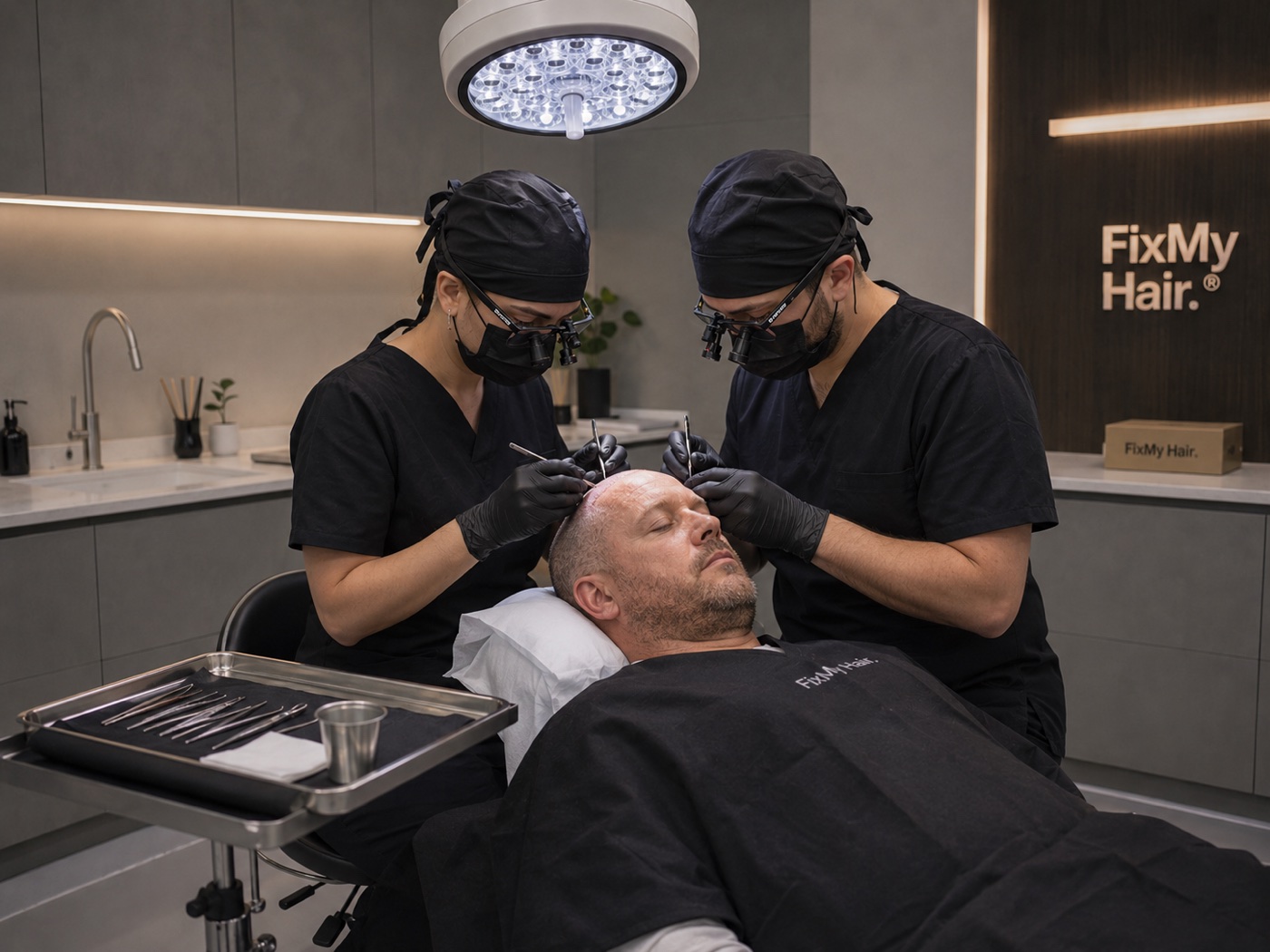
FUE hair transplant procedure in progress — Fix My Hair
Sapphire FUE · FUT · DHI

Hair Transplant

Most clinics tell you what you want to hear. We tell you what's actually right for you.

GMC Registered· Sapphire FUE· 1,500+ procedures· From £3,500
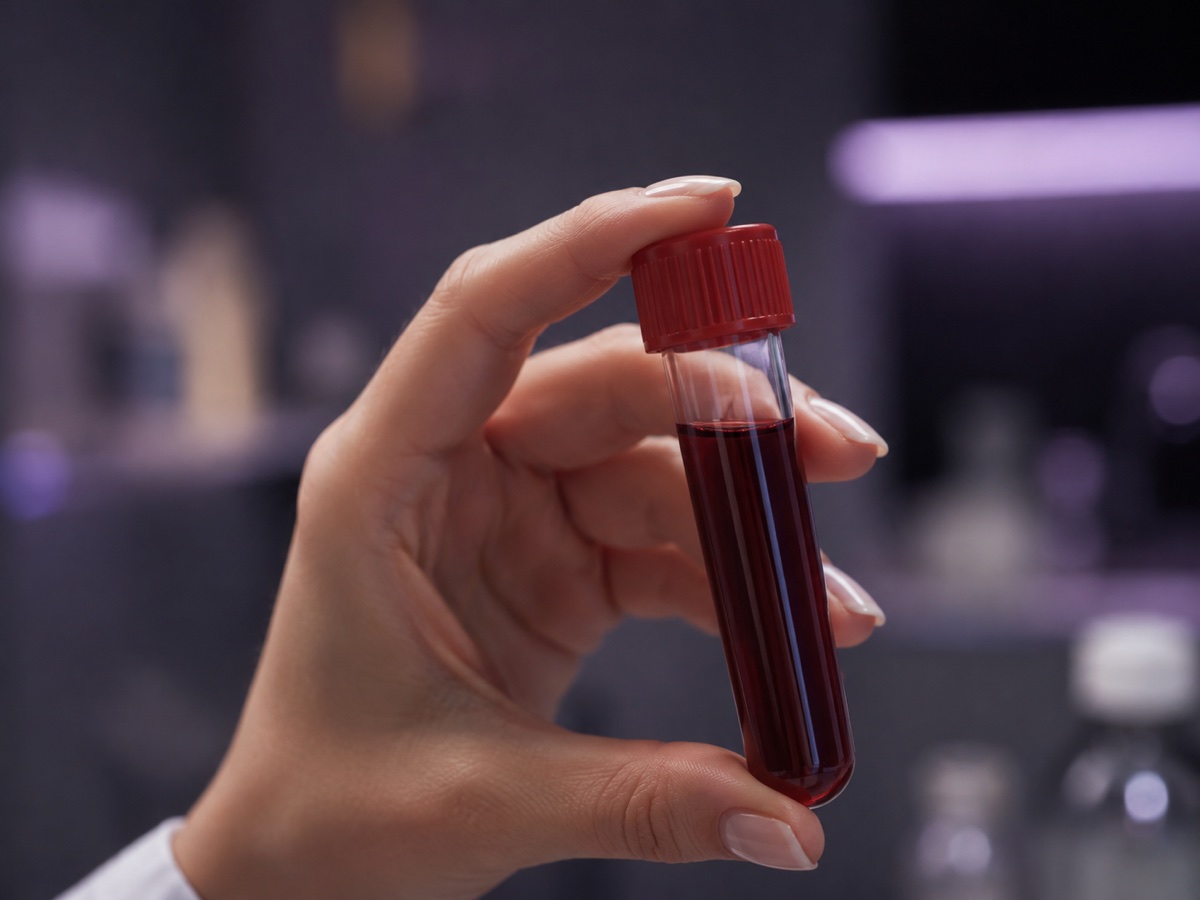
Diagnosis first

Before we recommend surgery, we run a full blood panel.

Most clinics skip this. We don't — because hair loss has a cause, and the cause changes the plan.

Comprehensive hair-health blood panel
1
Ferritin (iron stores)
The most under-diagnosed cause of hair loss — starves follicles long before anaemia shows.
2
Thyroid (TSH, T3, T4)
Both over- and under-active thyroid trigger shedding, often before any other symptom.
3
Hormones — Testosterone & DHT
DHT drives pattern loss. Your levels tell us whether medication will work alongside surgery.
4
Vitamin D
Every follicle has a Vitamin D receptor. Deficiency — very common in the UK — disrupts the growth cycle.
5
Full Blood Count
The foundation — reveals underlying conditions that surface in your hair before anywhere else.
6
Liver function
Confirms your body is ready for any medication we may prescribe around your procedure.
7
Lipid profile
Circulation feeds the scalp — follicles are among the first tissues to feel poor blood supply.

Your treatment plan is built around your biology — not a textbook average.

Zone breakdown

Where your grafts go.

Tap any zone to understand what happens there.
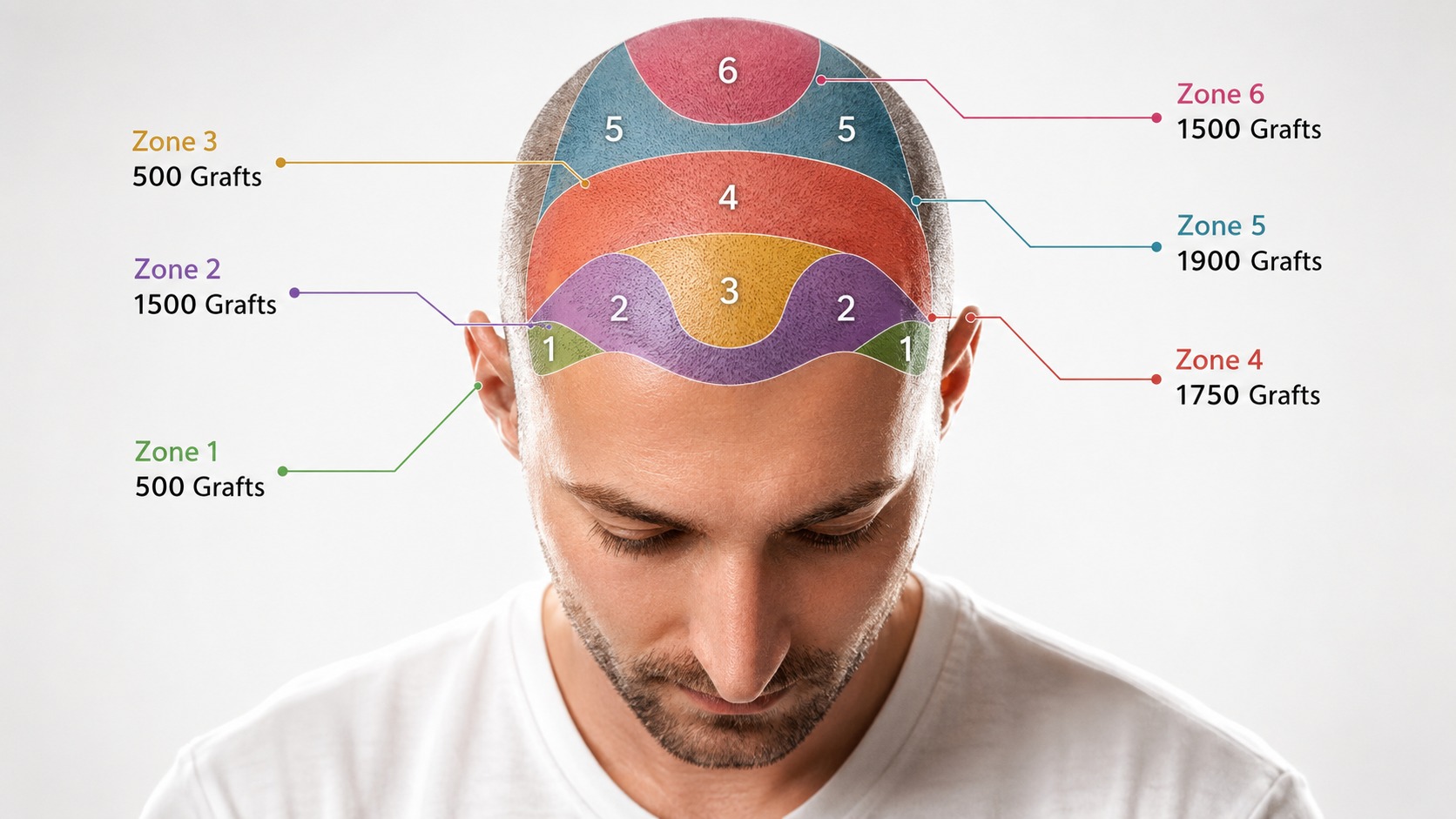
Front view · drag or swipe →
Front view — hair transplant zones 1 to 6
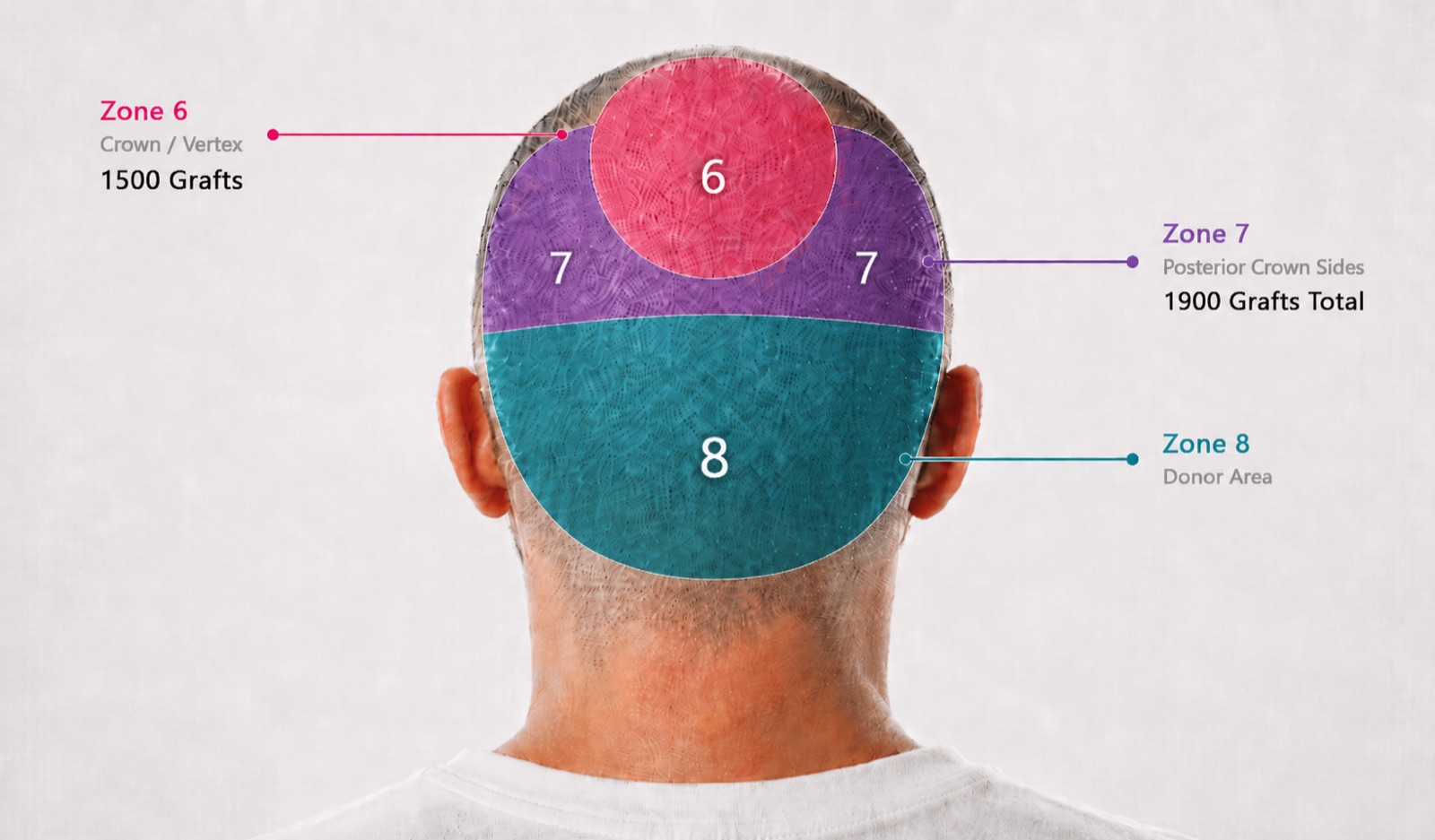
Back view — crown, rear crown sides and donor zone

All 8 zones · approx. 9,650 grafts total · 2 sessions typically recommended

Individual zones from £3,500 · Subject to status · Confirmed at consultation

Not sure which zones apply to you? →

The procedure

How FUE actually works.

Phase 1 · Extraction
One follicle at a time.
SKIN SURFACE Dermal papilla Sebaceous Arrector pili muscle 0.8mm micro-punch

Individual follicular units — natural groupings of 1–4 hairs — are extracted one by one from your donor zone with a 0.8mm precision micro-punch. No strip, no stitches, no linear scar.

Phase 2 · Incisions
2,847 micro-incisions. Each placed by hand.

The angle, depth and direction of every incision determines whether your result looks natural. This is where the artistry lives — and why the surgeon, not a technician, does it.

Phase 3 · Implantation
Why Sapphire FUE.
SAPPHIRE Smooth V-channel · less trauma · denser packing STEEL Rougher edge · more trauma · slower healing

Sapphire blades cut a smoother, narrower channel than steel — less tissue trauma, faster healing, and grafts packed closer together for denser, more natural results. Each graft is then placed into its channel by hand.
FUE vs FUT vs DHI

Sapphire FUE
Most popular
✓ No linear scar — tiny dots
✓ Faster healing, minimal downtime
✓ Shaved or unshaven options
4–8 hours depending on grafts
FUT
For larger sessions
High graft yield in one session
One fine linear scar, easily hidden
No need to shave the donor area
4–6 hours
DHI
Precision placement
Implanter pen — no pre-made channels
Excellent for dense, defined hairlines
Often unshaven-friendly
Discussed at consultation
Your day

Here's exactly what happens on the day.

08:00
Arrival and a warm welcome from your coordinator. Tea, coffee, and time to settle.
08:30
Hairline design with Dr Band — drawn with you, in the mirror. It takes as long as it needs to.
09:00
Local anaesthetic — a few small injections. This is the only discomfort of the entire day.
09:30
Extraction begins. Headphones on, a film or a playlist — most patients drift off to sleep.
11:00
Incision phase — Dr Band works by hand, placing the foundation for a natural result.
13:00
Lunch break. Stretch your legs, eat, relax. No rush.
14:00
Implantation begins — every graft placed into its channel, one by one.
17:00
Done. Your aftercare kit, clear instructions, and a car home. That's it.
This is what 12 months looks like.
FUE · Real patient · 12 months post-procedure · Patient consent obtained
The 12-month journey

What happens, month by month.

Month 1
Shock loss — and why it's good news.
Your transplanted hairs fall out in weeks 2–4. This frightens people who weren't warned — so here it is: it's completely normal and expected. The follicle beneath is alive and resting. What falls is just the shaft. Growth comes from underneath.
Result so far0%
Month 3
The first signs.
New hairs begin to push through — fine and soft at first. This is the month most patients first smile in the mirror.
Result so far0%
Month 6
Around 60% density.
The result is now clearly visible — thicker, fuller, framing your face. Most patients are delighted here, and it keeps improving.
Result at 6 months
Result so far0%
Month 12
Your full result.
Permanent, growing, and yours. The hairs mature, thicken and blend completely with your existing hair.
Full result at 12 months
Final result0%
Real outcomes

Transplant results.

All results →

Drag any photo to reveal 12 months. Results may vary; shown with patient consent.

Honest comparison

Fix My Hair vs most clinics.

Fix My Hair
Most clinics
Blood tests first
Always included
Usually skipped
Same surgeon throughout
Dr Band, every step
Technicians
Aftercare
2 years included
Generic or none
PRP & Polynucleotides
Full course included
Charged extra
If results need perfecting
Free top-ups
You pay again
Pricing
Fixed by size
Per-graft, inflated
Finance
0% over 12 months
Often none
Transparent pricing

Fixed by size. Never per graft.

Small · up to 3,000 grafts
from £3,500
or £292/month · 0% interest
Large · 3,000+ grafts
from £4,500
or £375/month · 0% interest

Every price includes your blood panel, Sapphire FUE surgery, a full course of PRP & Polynucleotides, 2 years of structured aftercare, free top-ups if needed, hotel and taxi on the day, and a surgeon-led consultation. Nothing hidden.

0%Interest-free finance over 12 months on all procedures.

Subject to status. Full terms available at consultation.

Surgeon-led, always

Dr Hisham Band.

"Not everyone needs surgery — and that's where most clinics go wrong. My job is to tell you what's actually right for you, not what generates the highest invoice."
GMC-Registered · FUE, FUT & DHI Specialist · Plastic & Reconstructive background (UCL) · EMMAA Medical Committee · 1,500+ procedures
Common questions

Everything you want to know.

If you have thinning or receding hair and enough healthy donor hair at the back and sides, you're likely a candidate. We confirm this properly at your consultation — and we'll tell you honestly if surgery isn't right for you yet.
Natural results come from the angle, density and direction of each graft — placed by hand by the surgeon, not a technician. A well-designed hairline is undetectable, even up close.
It depends on your pattern and goals — typically 1,500–3,500 in a session. Use the 3D explorer and calculator above for a rough idea, then we confirm exactly at consultation.
The only discomfort is a few small anaesthetic injections at the start. After that, nothing — most patients relax, watch films or sleep through the day.
Transplanted hairs shed in weeks 2–4 — this is normal and expected. The follicle stays alive beneath the surface and regrows from month 3. It's a sign things are working, not failing.
We harvest carefully and evenly so the donor area stays dense. Your donor hair is genetically resistant to thinning — it keeps that permanence wherever it's placed.
Most patients return after 2–3 days. There's mild redness for a few days; we'll talk through covering it and the timeline at your consultation.
Yes — for suitable candidates with stable donor hair. Female hair loss often has a hormonal cause, which is exactly why we run the blood panel first to find the right plan.
Many results are achieved in one session. Larger or more advanced patterns may be staged across two — we plan this honestly with you up front, never as a surprise.
First growth at month 3, around 60% density by month 6, and your full result at 9–12 months as the hairs mature and thicken.

When you're ready, we're here.

Chat on WhatsApp
From the journal

Worth reading before you decide.

Clear, clinician-reviewed guides from the Fix My Hair journal.
Explore all articles →