Does SMP Look Natural?
 Written by the Fix My Hair Editorial Team · Clinician-reviewed by Dr Hisham Band · GMC No. 7550130 · Last reviewed 10 Jun 2026
Done badly, SMP looks like a flat, solid tattoo. Done well, nobody can tell. The difference is technique — and realistic expectations.
Why good SMP disappears
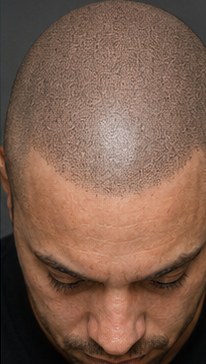
Natural results come from varied dot sizes, depths and pigment tones that replicate how real follicles scatter across the scalp — never a uniform block of colour.
Matched to you
Pigment is mixed to your skin tone and hair colour, and the hairline is designed soft and age-appropriate. That’s what keeps it believable up close.
Setting expectations
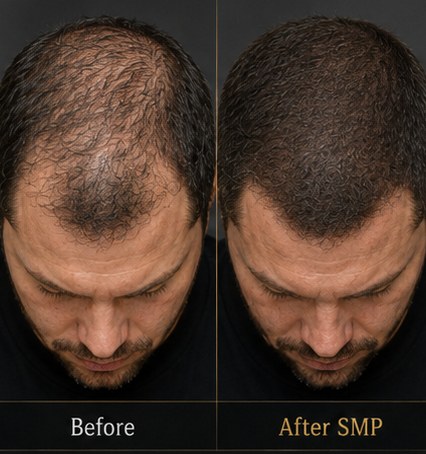
SMP recreates the appearance of density — it won’t grow hair. Understood that way, it’s one of the most natural-looking options in hair restoration.
The short answer
In skilled hands, yes — good SMP is genuinely undetectable at conversational distance, and most people would never guess. Bad SMP, on the other hand, is obvious. The difference comes down almost entirely to the practitioner’s skill and the choices made during the procedure, which is why who does your SMP matters more than almost anything.
What makes SMP look natural
- Dot variation — real follicles vary in size, depth and spacing; natural SMP mimics that randomness rather than placing uniform dots.
- The right pigment and depth — placed too deep or with the wrong ink, dots spread and turn bluish; placed correctly, they stay crisp and true to tone.
- A soft, age-appropriate hairline — a natural hairline is irregular and slightly broken, never a hard, straight line.
- Colour matched to you — pigment toned to your hair and skin, with grey blended in for older clients.
What gives bad SMP away
The tell-tale signs of poor work: dots that are too big, too uniform or too dark; a hairline that’s too low, too straight or too defined; and pigment that has turned blue or faded patchily. Almost all of these come from an inexperienced practitioner or the wrong technique — not from SMP itself.
Setting realistic expectations
SMP recreates the look of a closely-shaved scalp or added density — and it’s convincing for exactly that. What it can’t do is look like long, flowing hair, because it’s pigment at skin level, not hair with length. For the shaved look it’s most convincing when your own hair is kept short to match; the realism comes from the blend of pigment and stubble. Going in understanding what SMP is — and isn’t — is the key to being delighted with it.
Close up versus across the room
At normal social distances SMP is essentially invisible as anything other than short hair. Very close up — nearer than most people ever get — an observer might notice the dots sit at skin level rather than projecting as hairs, especially under harsh light. For the vast majority of real-world situations that’s irrelevant; the result reads as a clean, full buzzcut.
Common questions
Will people know I’ve had it done? Generally only if you tell them — well-done SMP simply looks like closely-cropped hair.
What if my SMP looks unnatural? Usually a technique issue that can often be corrected or softened; choosing an experienced practitioner up front avoids it.
Key takeaways
- Natural SMP uses varied dots, not a solid block
- Pigment is matched to skin and hair tone
- A soft, age-appropriate hairline is key
- It mimics density — it doesn’t grow hair
- In skilled hands it’s undetectable