Hair Restoration Glossary
 Written by the Fix My Hair Editorial Team · Clinician-reviewed by Dr Hisham Band · GMC No. 7550130 · Last reviewed 10 Jan 2026
Hair restoration has its own language, and clinics don’t always take the time to translate it. Here are the 25 terms worth knowing, in plain English.
A to Z · 5-alpha reductase · Alopecia · Anagen · Androgenetic alopecia · Catagen · DHI · DHT · Donor zone · Follicle · Follicular unit · FUE · FUT · Graft · Hairline design · Ludwig Scale · Miniaturisation · Norwood Scale · Recipient zone · Sapphire FUE · Shock loss · Telogen effluvium · Telogen · Traction alopecia · Vertex
5-alpha reductase
The enzyme that converts testosterone into DHT. Finasteride works by blocking it.
Alopecia
The medical term for hair loss of any kind, from any cause.
Anagen phase
The active growth phase of the hair cycle, lasting 2 to 7 years. Most of your hair is in anagen at any time.
Androgenetic alopecia
Male or female “pattern” hair loss, the genetic, DHT-driven type that accounts for most cases.
Catagen phase
The short transitional phase where the follicle shrinks and growth stops, lasting around two weeks.
DHI
Direct Hair Implantation, placing grafts with an implanter pen rather than pre-made channels, allowing dense, precise placement.
DHT
Dihydrotestosterone, the hormone that shrinks genetically sensitive follicles and drives pattern hair loss.
Donor zone
The back and sides of the scalp, where hair is genetically resistant to DHT. This is where grafts are taken from.
Follicle
The tiny organ in the skin that produces a hair. Each follicle cycles through growth, transition and rest.
Follicular unit
A natural grouping of 1 to 4 hairs that emerge together. Transplants move these intact units.
FUE
Follicular Unit Excision, extracting grafts individually, leaving no linear scar.
FUT
Follicular Unit Transplantation, removing a strip of donor skin for a high graft yield, leaving a fine linear scar.
Graft
A single transplanted follicular unit, one of the building blocks of your result.
Hairline design
The bespoke shape and position of the new hairline, drawn by hand to suit your face and age.
Ludwig Scale
The staging system for female pattern hair loss, describing diffuse thinning across the crown.
Miniaturisation
The gradual shrinking of a follicle under DHT, producing finer, shorter hairs over successive cycles.
Norwood Scale
The seven-stage staging system for male pattern hair loss.
Recipient zone
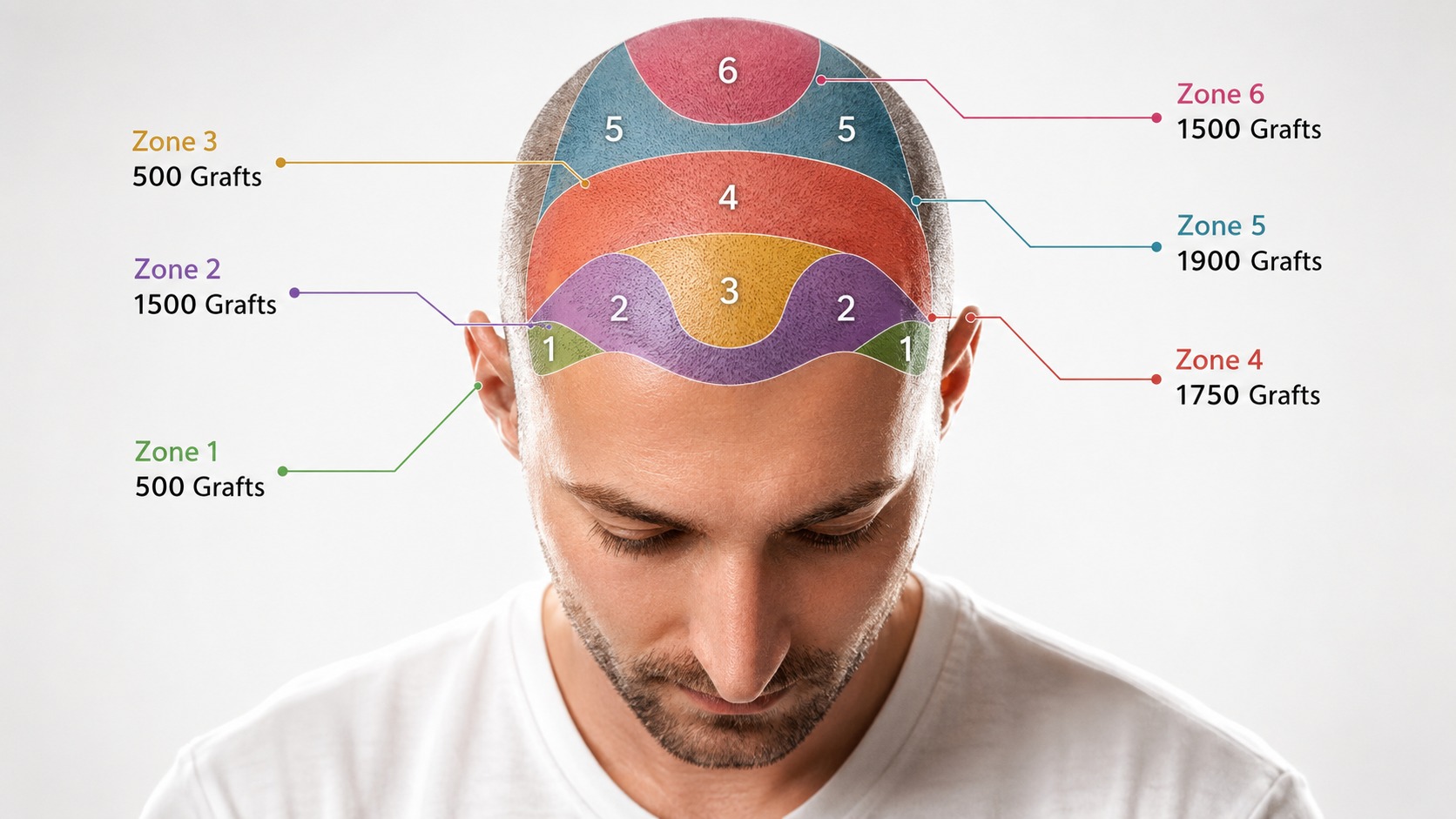
The thinning area where grafts are placed.
Sapphire FUE
FUE using a sapphire blade to cut finer, smoother channels, less trauma and denser packing.
Shock loss
Temporary shedding of transplanted (and sometimes native) hair after surgery. The follicle survives and regrows.
Telogen effluvium
Diffuse shedding triggered by stress, illness or deficiency, usually temporary.
Telogen phase
The resting phase of the hair cycle, after which the hair sheds and the follicle restarts.
Traction alopecia
Hair loss caused by repeated tension, tight ponytails, braids or extensions.
Vertex
The crown of the head, the swirl area that is often the last to respond after a transplant.
Key takeaways
- Anagen, catagen and telogen are the three phases of the hair cycle
- DHT and 5-alpha reductase drive pattern loss
- FUE, FUT and DHI are graft techniques, not results
- The donor zone is DHT-resistant
- Norwood (male) and Ludwig (female) stage the loss