Back in the ring: contact sport after a hair transplant
 Drafted by the Fix My Hair editorial team · Clinically reviewed by Dr Hisham Band · GMC No. 7550130 · Last reviewed 21 Oct 2026
In one breath: New grafts can be knocked loose for about the first nine days. After that they are part of you, and the risks that remain are sweat, blood pressure and knocks to skin that is still healing. That is why light training comes back within weeks but full contact waits at least six. Plan the surgery around your season, not the other way round.
Two clocks: when grafts set
In 2006 the American hair surgeons Bernstein and Rassman did something most patients would rather not think about. In 42 patients, they gently pulled on a few grafts at set times after surgery to find out when a graft could no longer be removed [1].
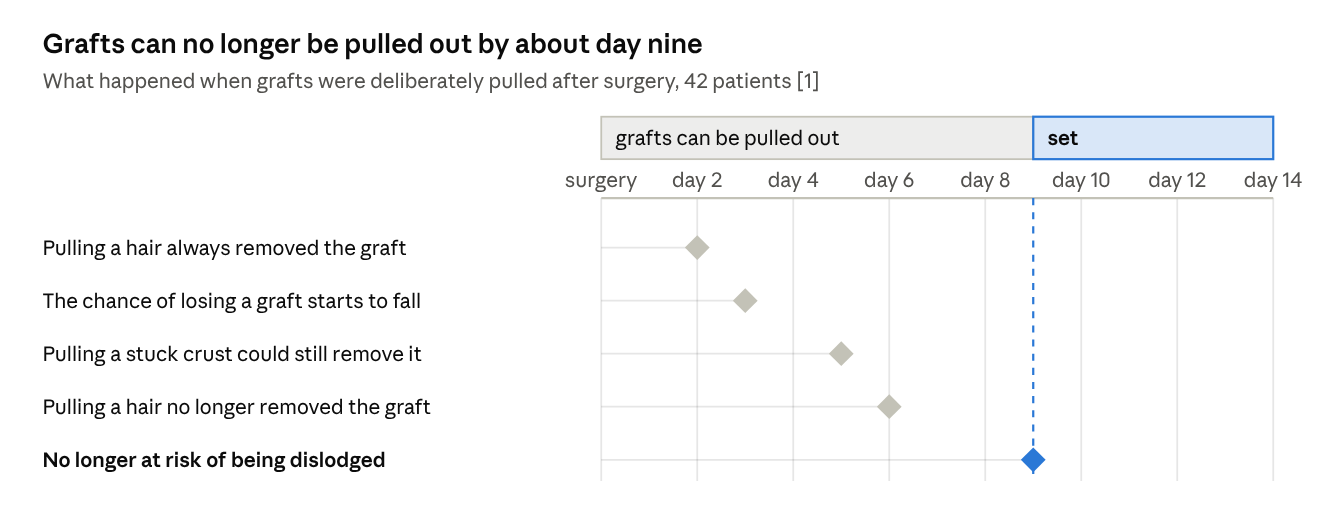
For the first two days, pulling on a hair always brought the graft out. From day three the odds started to fall. By day six a pull on the hair no longer removed it, though a pull on a crust stuck to the graft still could up to day five. By day nine, grafts were no longer at risk of being dislodged [1].
That is the first clock, and it is short. The second clock is the skin around the grafts and the donor area at the back, and it runs for weeks.
The picture: fence posts in fresh concrete
Think of each graft as a fence post set in wet concrete. For the first day or two, a tug pulls the post straight out. As the concrete sets, the post holds. A week and a bit later, you could lean on it.
The picture breaks in two useful places. Concrete sets at the same speed whatever you do, but grafts don't: crusts stuck to a graft keep it at risk for longer, which is why gentle washing in the first days matters [1]. And concrete is finished once it sets. Skin isn't. The surface heals over in days, but the tissue underneath, and a strip scar at the back if you had FUT, keeps strengthening for weeks to months [2]. That second, slower clock is what sets the date for full contact.
Three things sport does to a healing scalp
- It raises blood pressure. Heavy lifting, sprints and sparring push blood to the head. In the first week that can start bleeding around grafts that have barely settled.
- It makes you sweat, and shares your sweat. Sweat and bacteria sit on healing skin. Infection around grafts usually shows as small red, pus-filled spots [2]. Shared headgear, pads and mats add other people's skin to the mix.
- It brings impact and friction. Gloves, heads, elbows, the floor, a scrum cap rubbing for eighty minutes, a helmet strap. Early on that can dislodge grafts. Later it can irritate skin or stretch a donor wound that is still remodelling [2].
None of these lasts forever. Each fades on its own timetable, and the plan below follows them.
The return plan, sport by sport
Each activity comes back when the risk it carries has faded. Walking is fine from the first days. Anything with head contact comes back last.
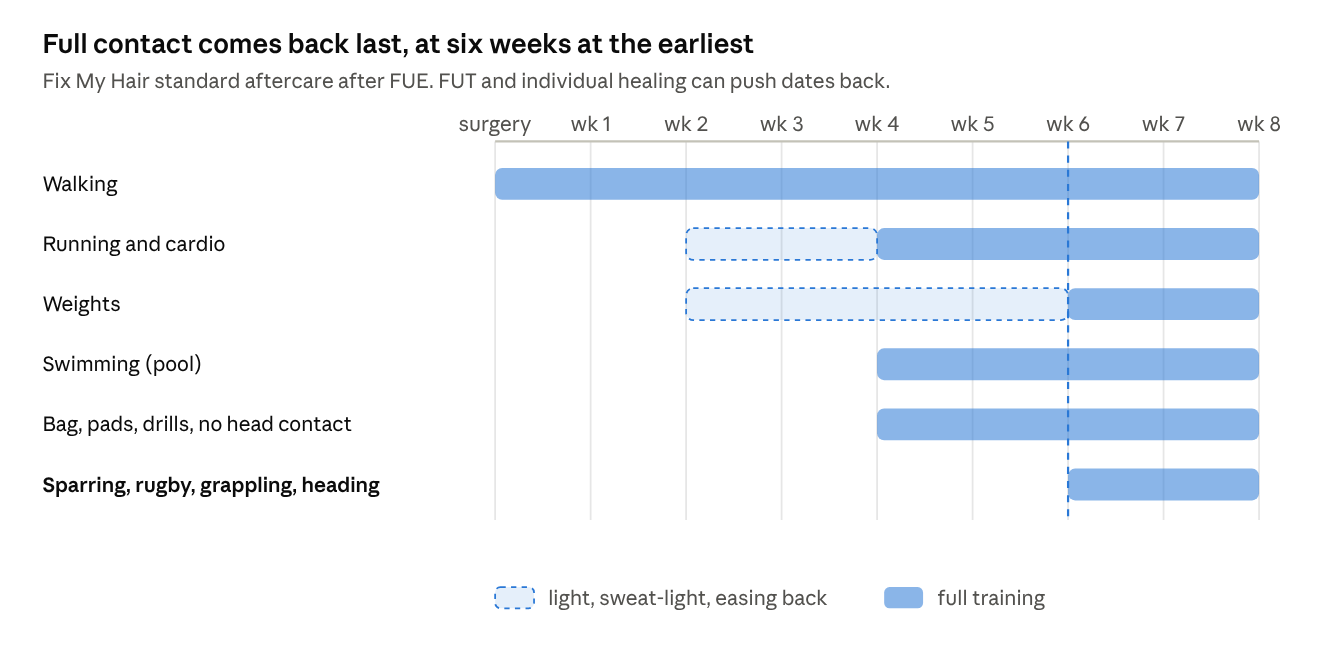
The light phase means what it says: no straining, no soaking sweat, nothing pressing on the grafts, and stop if the grafted area throbs. The six-week mark for contact is the earliest date, not a target. If you had FUT, or your surgeon isn't happy with the healing at review, it moves. The week-by-week plan is Fix My Hair's standard aftercare guidance, matching exercise after a hair transplant. Your surgeon may change it for you.
Notes by sport
- Boxing, MMA, kickboxing, wrestling, BJJ. Bag work, pads and drills with no contact to the head can come back before sparring does. Grappling is the hardest to protect, because the head is on the mat and in other people's arms. Mats also carry skin infections, so wait until the scalp has fully healed, and wash straight after every session.
- Rugby. Scrum caps rub, and rucks and tackles bring the head into contact constantly. Treat any session with contact as contact, not just matches.
- Football. Running and ball work return early. Heading is head contact, so it waits with the contact sports.
- Cycling, riding, cricket, hockey. The issue is the helmet, not the sport. Pressure and rubbing over grafts in the first weeks is what to avoid. When it goes back on, it should sit without pressing on the grafted area. Never ride without one to protect grafts.
- Swimming. About four weeks for a pool, longer for the sea or open water. Outdoors, the sun matters too: see sun exposure after a hair transplant.
Planning surgery around a season or a fight
Count back from your next date that matters. You need at least six weeks before full contact, and your surgeon may want longer if you had FUT. Add a buffer for the review appointment.
Then think about how you'll look. Transplanted hairs usually shed between weeks two and six, and visible regrowth starts from around month three. If you have a weigh-in, a televised fight or a team photo in that window, the grafted area will look thinner, not thicker. The shedding phase explains why this is normal, and the follicle cycle explains the biology behind it.
One more thing for combat athletes: a hard weight cut can itself trigger shedding a couple of months later. Stacking a big cut on top of recent surgery makes it harder to tell what is causing what.
If you take a knock in the first fortnight
- Don't rub or pick at the area. Press gently with clean gauze if it bleeds.
- A dislodged graft usually shows as a spot of bleeding, sometimes with a tiny piece of tissue on the gauze. One or two lost grafts among hundreds won't change the result much.
- Send a clear photo to your surgeon's team the same day.
- After about day nine, grafts are no longer at risk of being pulled out [1]. A knock after that is just a knock to the head, and the usual concussion rules apply as they would to anyone.
For coaches, physios and sports doctors
You will often see the athlete more than the surgeon does in the weeks after surgery. A short checklist:
- Ask the date of surgery and whether it was FUE or FUT (a linear stitched wound at the back).
- No head contact, headgear rubbing or heavy straining before the surgeon has cleared it.
- Watch for signs of infection: spreading redness, pus, increasing pain or fever. Refer back to the surgeon.
- For FUT: no heavy neck flexion work or loaded neck training until the donor wound has been checked [2].
- Personal headgear only, washed, until the scalp has fully healed.
- Any head knock is assessed for concussion exactly as it would be without the surgery. The scalp wound does not change the protocol.
For clinicians
- Shorten the risk window by preventing crusts. In Bernstein and Rassman's study, adherent crusts kept grafts at risk for longer; their conclusion was that preventing crusting could shorten that period [1]. A clear washing routine from day one is part of graft security, not just comfort.
- Ask about sport at consultation, not at discharge. The sport and the calendar change the plan. A professional fighter in camp is a different booking from a recreational runner.
- FUT in contact athletes. Counsel on donor wound strain and neck flexion, and consider delaying suture removal where activity is likely to load the wound early [2]. Some athletes will be better served by FUE for this reason alone.
- Write the return plan down, sport by sport, and give it to the athlete to show their coach. Verbal advice gets lost in a team environment.
- Document the donor at the review visit before clearing contact sport, with standard photographs.
Teach it back
- Roughly how many days before a graft can no longer be pulled out, and what makes that window longer?
- Why can you be back on the bag before you are back to sparring?
- A rugby player had FUT. Which part of their scalp sets the date for full contact, the front or the back, and why?
References
- Bernstein RM, Rassman WR. Graft anchoring in hair transplantation. Dermatol Surg. 2006;32(2):198-204. PubMed 16442039
- Kerure AS, Patwardhan N. Complications in hair transplantation. J Cutan Aesthet Surg. 2018;11(4):182-9. PubMed 30886471
Medical note: This article is general information, not medical advice. Whether a hair transplant or any treatment suits you is confirmed only at a consultation with a GMC-registered doctor. Results vary from person to person.