Why the back of your head never goes bald
 Drafted by the Fix My Hair editorial team · Clinically reviewed by Dr Hisham Band · GMC No. 7550130 · Last reviewed 21 Oct 2026
In one breath: The hair at the back and sides of your head is born resistant to the hormone that causes pattern baldness, and it keeps that resistance wherever it is moved. Surgeons call this donor dominance. Every hair transplant ever performed depends on it.
Look at any bald man from behind
Next time you're behind someone with very little hair on top, look at the back and sides. There is almost always a horseshoe of hair left, running from above one ear, round the back, to above the other. Men in their eighties still need that band trimmed.
That band is not luckier than the hair that went. It is made differently. The follicles in it simply don't respond to the hormone signal that shrinks the follicles on top, and that difference is written into them from the start.
The experiment that started hair surgery
In the 1950s a New York dermatologist, Norman Orentreich, was taking small round punches of skin from one part of the scalp and moving them to another. He found that plugs of hair-bearing skin taken from the back of the head kept growing hair after they were placed in bald areas. They did not go bald with the skin around them.
He published the work in 1959 and gave the idea its name: donor dominance [1]. The graft behaves like the place it came from, not the place it lands. Modern hair surgery, from strip surgery to FUE, is built on that one observation.
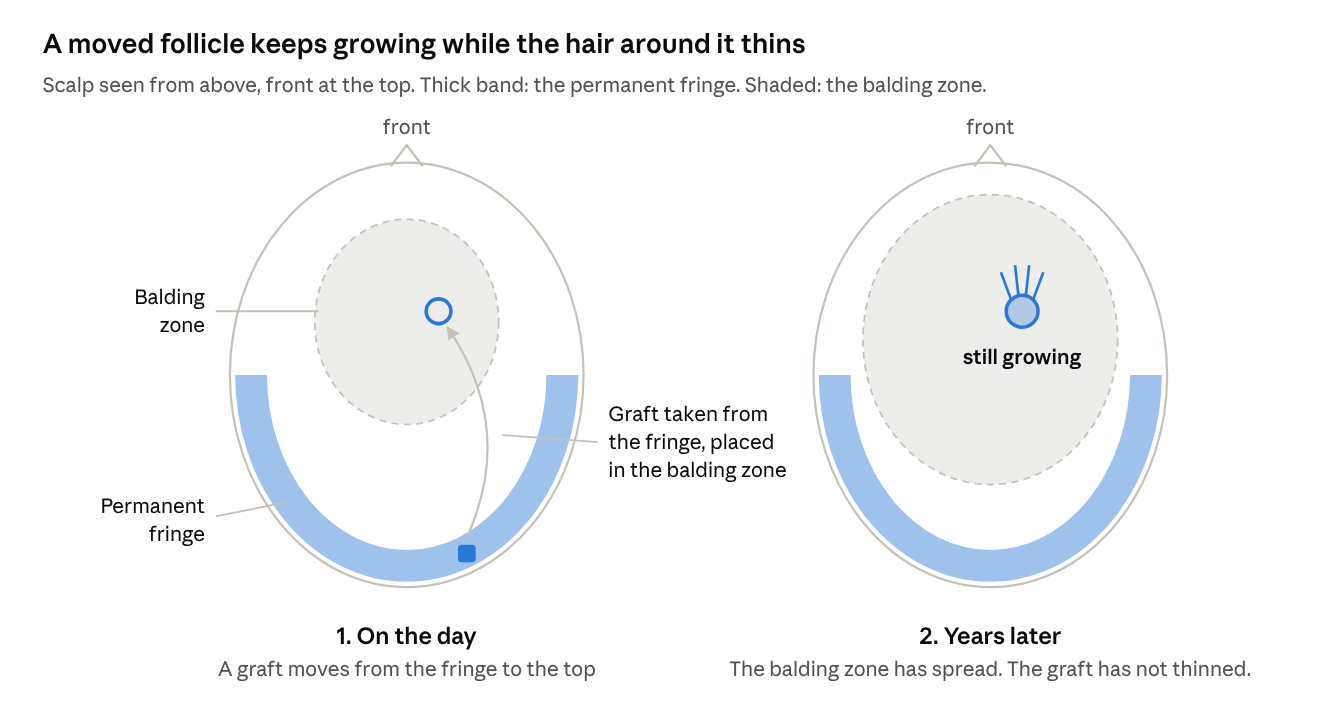
The part people often miss is what happens next. The moved hair keeps growing, but the hair that was already on top is still under the same hormone pressure as before. It can carry on thinning around the transplant.
The picture, and where it breaks
Think of a follicle as a bulb with its instructions sealed inside. Plant a tulip bulb from Holland in a garden in Leeds and it still comes up a tulip. The garden doesn't rewrite the bulb.
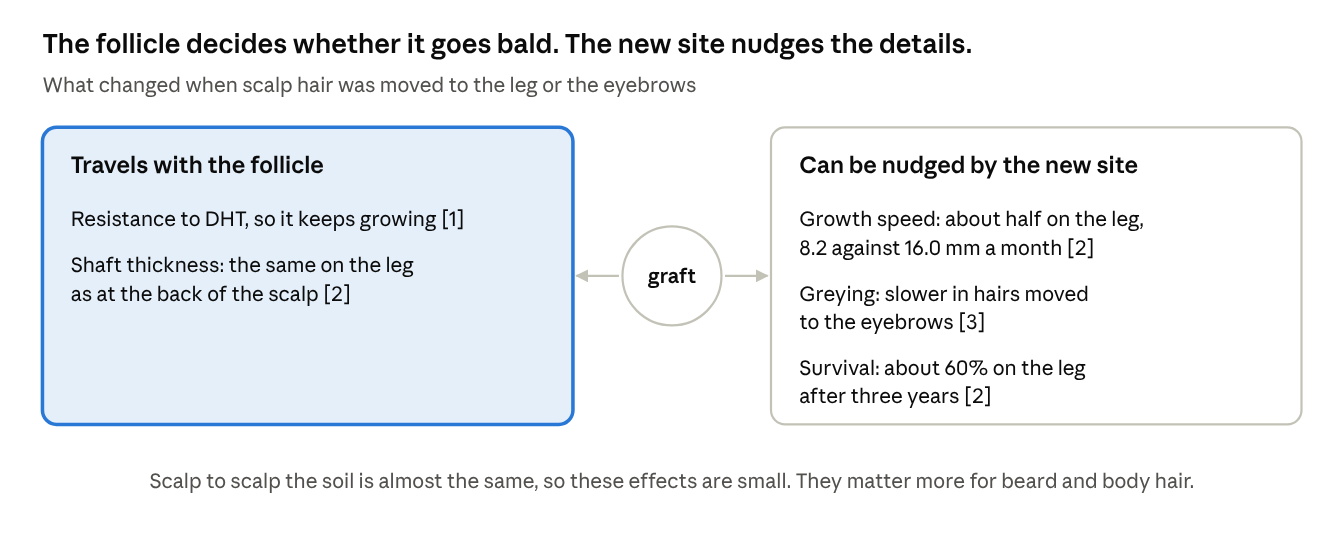
That comparison holds for the big question, which is whether the hair goes bald. It breaks on the details, because soil still matters. In 2002 a Korean surgeon moved hairs from the back of his own scalp to his leg and measured them for three years. The hairs on his leg kept their thickness, but they grew at about half the speed: 8.2 mm a month against 16.0 mm at the back of his head. About 60% of them were still there after three years [2]. An earlier study of scalp hairs moved into the eyebrows found they grew more slowly and turned grey more slowly than the hairs left behind on the scalp [3].
So a better version of the picture is this. The bulb decides what it is. The garden has some say in how fast it grows. The top and the back of the scalp are very similar soil, which is why scalp hair moved to the hairline behaves almost exactly as it did before. Beard or body hair moved to the scalp keeps more of its own habits.
What is actually happening inside the follicle
Pattern baldness needs two things at once: male hormones, and follicles that are sensitive to them. In 1942 the anatomist James Hamilton reported that men who never produced adult levels of male hormones did not develop common baldness [4]. Take away the hormone and the pattern doesn't appear.
The hormone that does the damage is DHT, made from testosterone by an enzyme called 5-alpha reductase. At the base of each follicle sits a small cluster of cells, the dermal papilla, which acts like a foreman telling the follicle how big a hair to make. In balding scalp, and in the beard, these cells carry more of the type 2 enzyme and respond strongly to DHT [5].
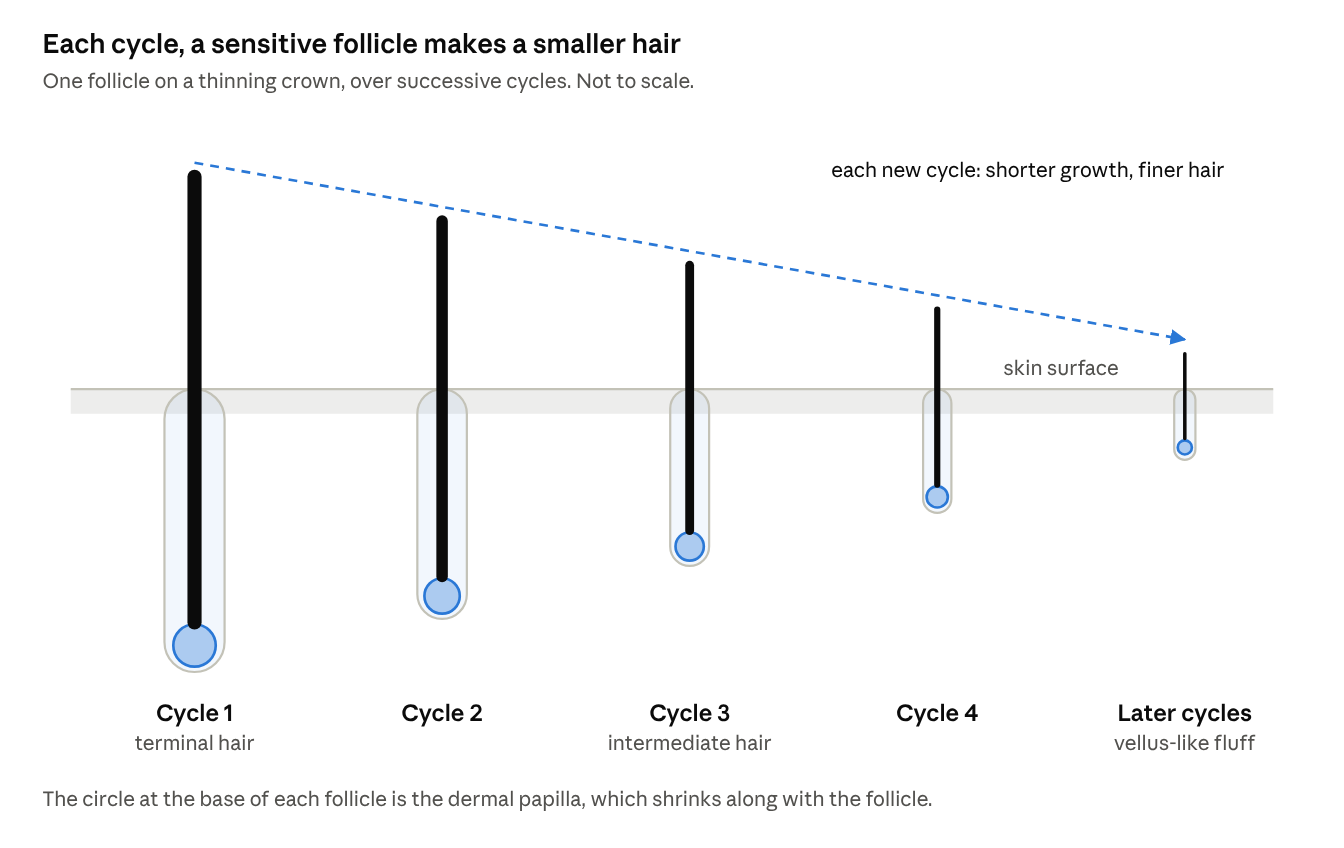
Here is the odd part. On the chin, DHT tells the foreman to build thicker hair. On the crown, the same signal tells it to build smaller and smaller hairs until they are barely visible. In the horseshoe at the back, the foreman mostly ignores the message. The hormone is the same everywhere. The response is set locally, by genes, follicle by follicle. How DHT shrinks a hair explains the shrinking step by step.
That is why moving a follicle works. The sensitivity lives in the follicle, so it travels with it.
The safe donor zone
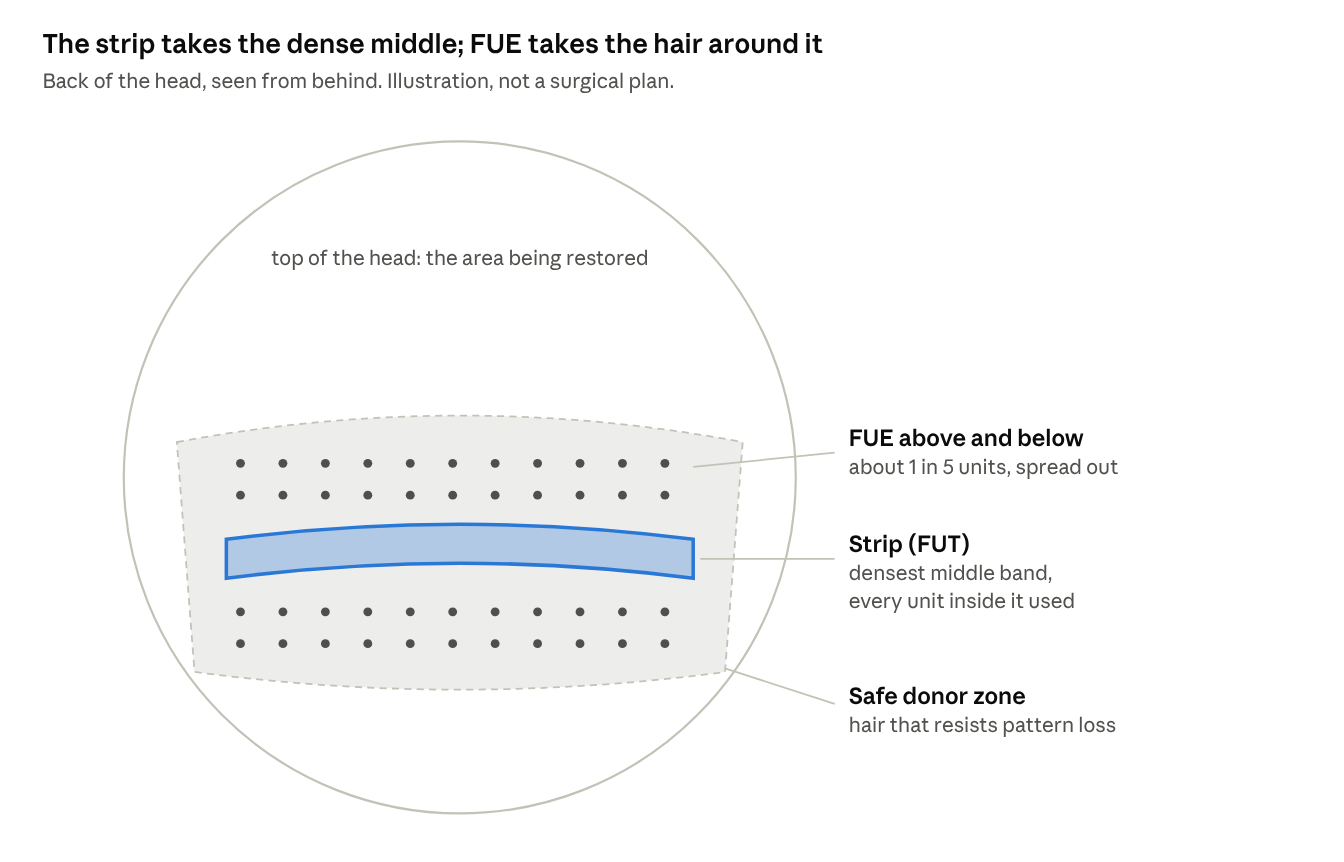
In 1994 Unger and colleagues examined older men to map where scalp hair is most likely to last into old age [6]. The answer is a band that runs from above one ear, round the back, to above the other. Surgeons call it the safe donor zone, and it is where grafts should come from.
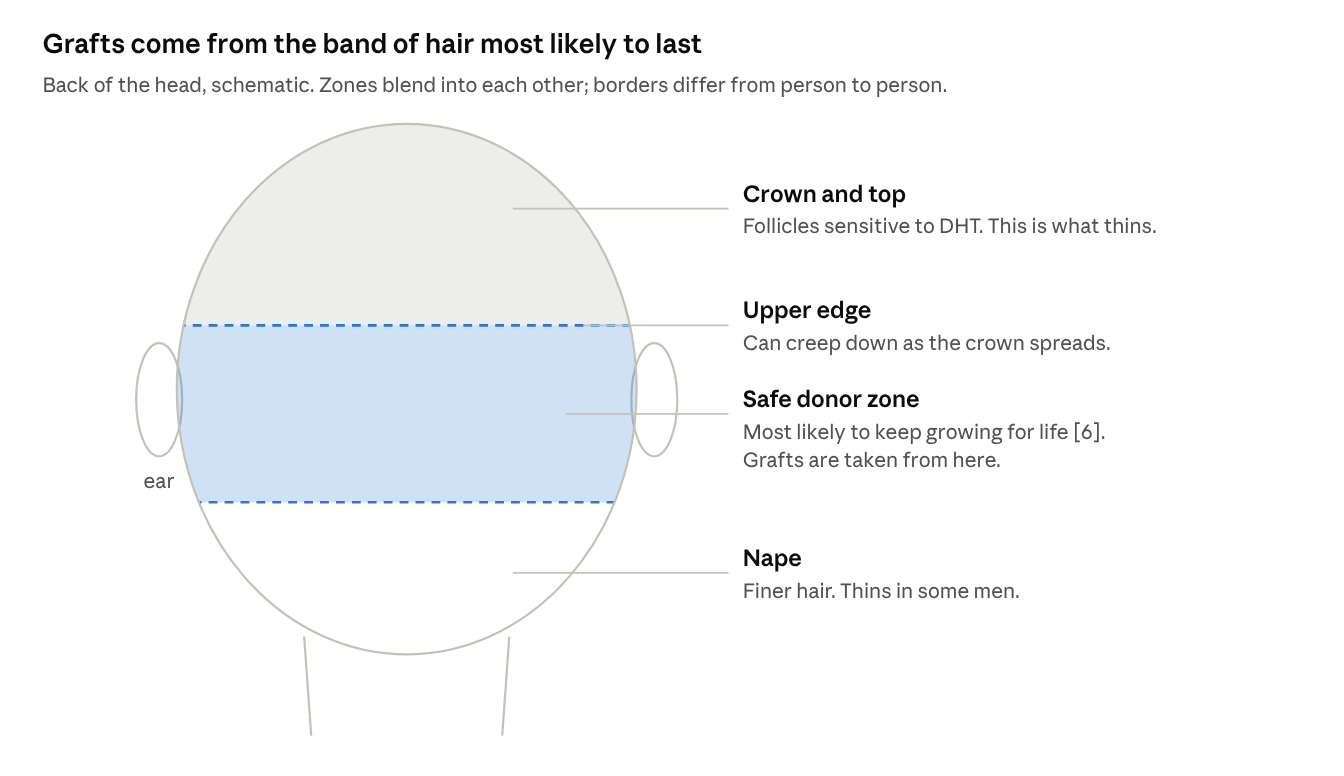
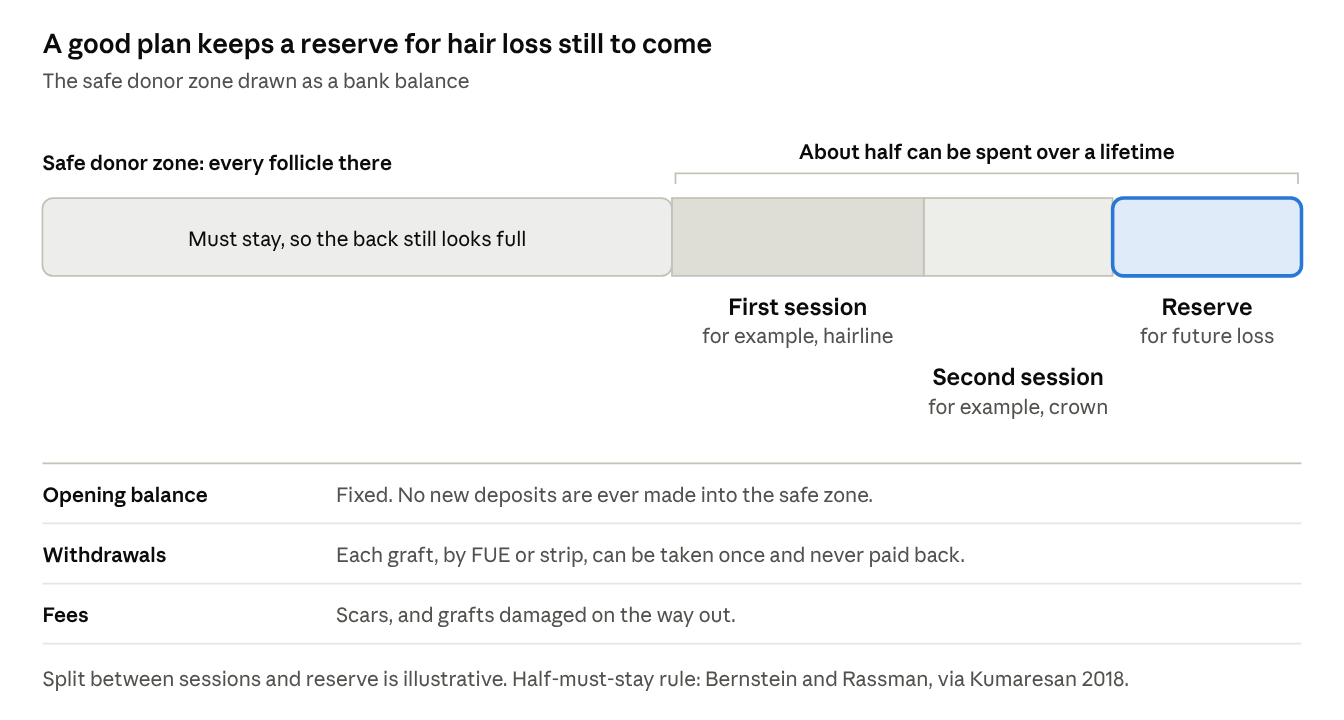
The middle of the band is the most reliable. The edges are where problems start. The upper edge can creep down as the crown spreads, and the nape below has finer hair that thins in some men. A small number of men also thin inside the band itself, sometimes called retrograde alopecia. That is why the donor area is examined closely, ideally with a dermatoscope, before anyone draws a plan. Your donor area is a bank account explains how much of it can be spent.
What this means if you are planning a transplant
- Transplanted hair lasts. The hair around it may not. Your own hair on top can keep thinning after surgery, so a good plan accounts for where your hair loss is heading, not just where it is today. Will my hair loss get worse? covers how that is judged.
- Your donor supply is limited. Only hair from inside the safe zone is worth moving, and each follicle can be moved once. How many grafts do I need? explains how the numbers are worked out.
- Age matters. At 22, nobody can be sure where the edges of your safe zone will settle. That is one reason surgeons are more cautious with younger patients (What age should I have a hair transplant?).
- The donor area gets examined first. If the hair at the back is already thinning, the plan changes, sometimes to no surgery at all. Am I a good candidate? walks through the checks.
For clinicians and technicians
- Map the donor before the recipient. Dermoscopy at several points across the band, recording calibre variation and density. Miniaturisation in the donor is a warning, not a footnote, and it is easy to miss on a quick look in clinic.
- Respect the edges. Wide FUE harvesting makes it tempting to take from the upper and lower margins of the band, where follicles are least likely to last. Grafts from there can thin years later in the recipient area, leaving a patchy result that is hard to repair. Be most conservative in patients under 30 and in those with a strong family history of advanced loss.
- Expect recipient effects with non-scalp donors. Beard and body hair keep their own growth rate and length limits to a large degree [2, 3]. They suit some zones (crown, density behind the hairline) better than others (the hairline itself).
- Counsel on progression. Donor dominance protects the grafts, not the native hair. Patients who understand this make better long-term plans and are less likely to blame the surgery for later thinning.
- Photograph the donor at baseline, in standard views, so later depletion can be measured rather than argued about.
Donor dominance is a strong rule, but it was drawn from observation, and the recipient-site studies show it is not absolute [2, 3]. Teach it as "the follicle decides whether it goes bald; the site can influence growth", which is closer to what the evidence supports.
Teach it back
If this article worked, you can now answer these without scrolling up.
- Why does a horseshoe of hair survive at the back and sides, even in men who are otherwise bald?
- Hair moved to a man's leg kept its thickness. What changed, and what does that tell you about donor dominance?
- After a transplant, which hair is protected from future thinning, and which isn't?
References
- Orentreich N. Autografts in alopecias and other selected dermatological conditions. Ann N Y Acad Sci. 1959;83:463-79. PubMed 14429008
- Hwang S, Kim JC, Ryu HS, et al. Does the recipient site influence the hair growth characteristics in hair transplantation? Dermatol Surg. 2002;28(9):795-8. PubMed 12269871
- Lee SH, Kim DW, Jun JB, et al. The changes in hair growth pattern after autologous hair transplantation. Dermatol Surg. 1999;25(8):605-9. PubMed 10491042
- Hamilton JB. Male hormone stimulation is prerequisite and an incitant in common baldness. Am J Anat. 1942;71:451-80.
- Inui S, Itami S. Molecular basis of androgenetic alopecia: from androgen to paracrine mediators through dermal papilla. J Dermatol Sci. 2011;61(1):1-6. PubMed 21167691
- Unger W, Solish N, Giguere D, et al. Delineating the "safe" donor area for hair transplanting. Am J Cosmet Surg. 1994;11:239-43.
Medical note: This article is general information, not medical advice. Whether a hair transplant or any treatment suits you is confirmed only at a consultation with a GMC-registered doctor. Results vary from person to person.