Your donor area is a bank account
 Drafted by the Fix My Hair editorial team · Clinically reviewed by Dr Hisham Band · GMC No. 7550130 · Last reviewed 21 Oct 2026
In one breath: The hair at the back and sides of your head is the only hair that reliably survives pattern baldness, and there will never be any more of it. Every graft is a withdrawal that cannot be paid back. A good plan spends it with the future in mind, because hair loss that starts young usually keeps going after the first operation.
An account with no deposits
Picture a bank account opened with one lump sum and no way to pay anything back in. Every purchase comes out of the same balance. Spend it all at 25 and there is nothing left at 40.
That is your donor area. Transplants work because hair from the back and sides resists the hormone that causes pattern baldness. But only hair from that band is worth moving, and once a follicle has been moved it is gone from the donor for good.
Donor area depletion is what happens when more grafts are taken from the back and sides than the area can give up while still looking full. Whatever the technique, the donor supply is one of the main limits on what surgery can do [1, 2].
How big is the balance?
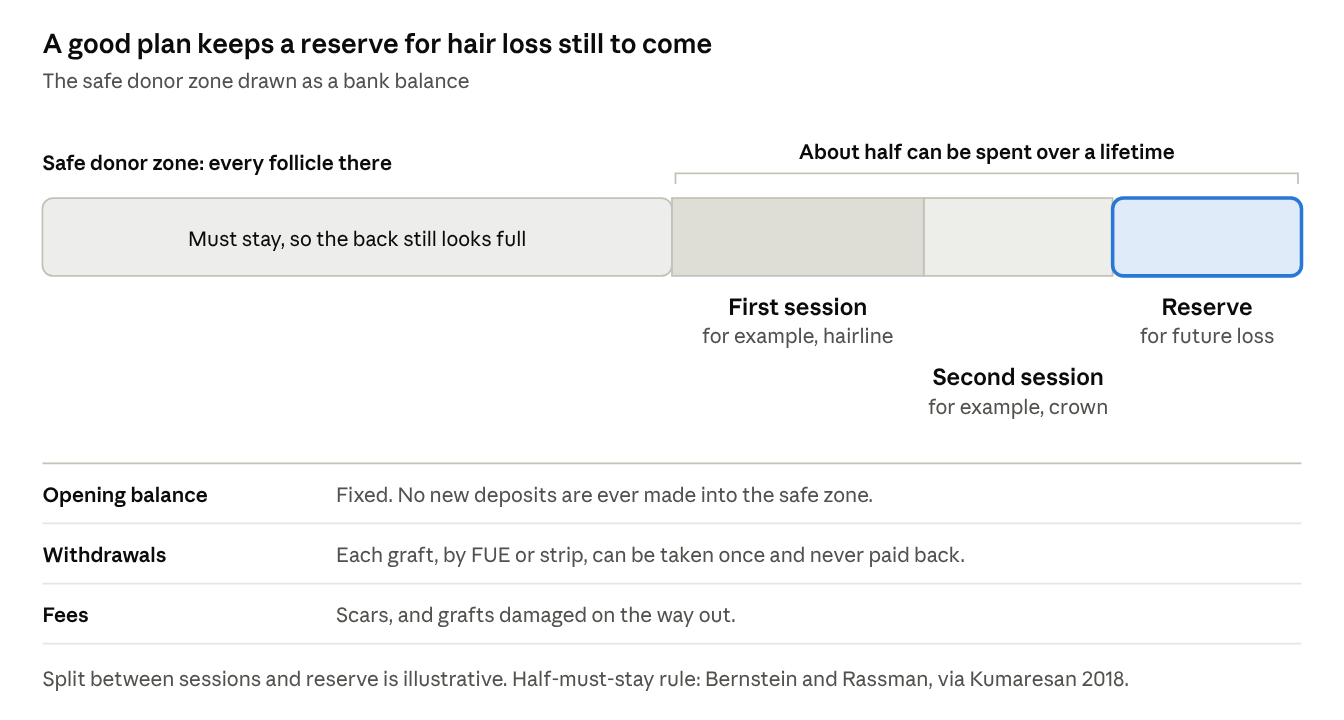
The safe donor zone covers roughly a quarter of the scalp, and only about half of the hair in it can be removed before the area looks thin. That rule of thumb comes from the surgeons Bernstein and Rassman [1].
So the spendable balance is about half of what sits in that band. The other half has to stay where it is, both to keep the back looking full and to hide the marks that surgery leaves.
Supply against demand
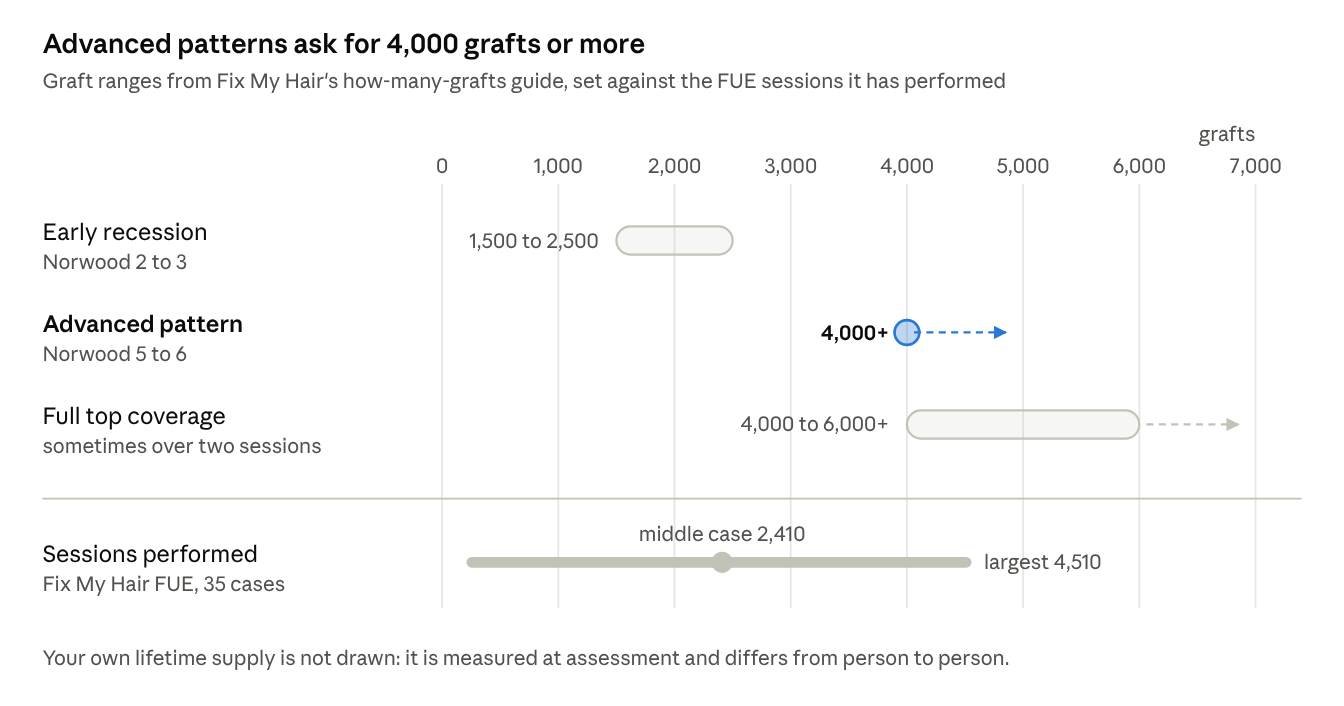
Demand grows as hair loss moves through the Norwood stages, the scale surgeons use to grade the pattern in men [3]. Fix My Hair's own guide puts early recession (Norwood 2 to 3) at around 1,500 to 2,500 grafts, and an advanced pattern (Norwood 5 to 6) at 4,000 or more.
Supply does not grow. The donor you have at 22 is the donor you will have at 52, and it may thin at its edges as you age. That is why the first plan has to be drawn with the last one in mind.
The picture, and where it breaks
The bank account picture holds for the big idea: finite supply, permanent withdrawals, the need to budget. It breaks in three places.
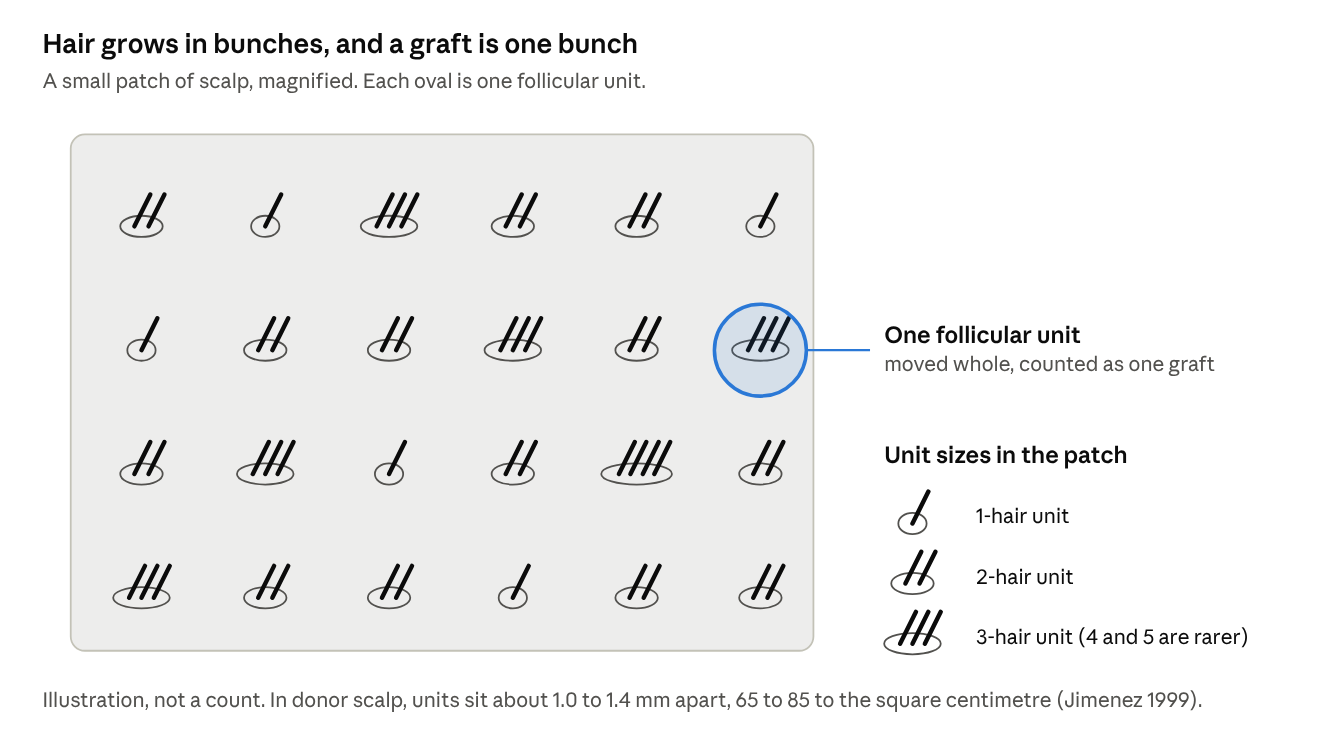
First, you do not know your balance until it is measured. Donor density varies a lot between people, from 65 to 85 follicular units per square centimetre in one study [4], and below 60 is generally treated as low [5]. The edges of the safe zone can also move, as the lower margin may creep upward with time [1].
Second, withdrawals carry fees. Every FUE punch leaves a small scar, and taking too many from one area leaves a patchy, moth-eaten look [6, 7].
Third, there is a second, smaller account. Beard and body hair can add to a depleted scalp donor, but it behaves differently and is less well studied [2].
What is actually happening
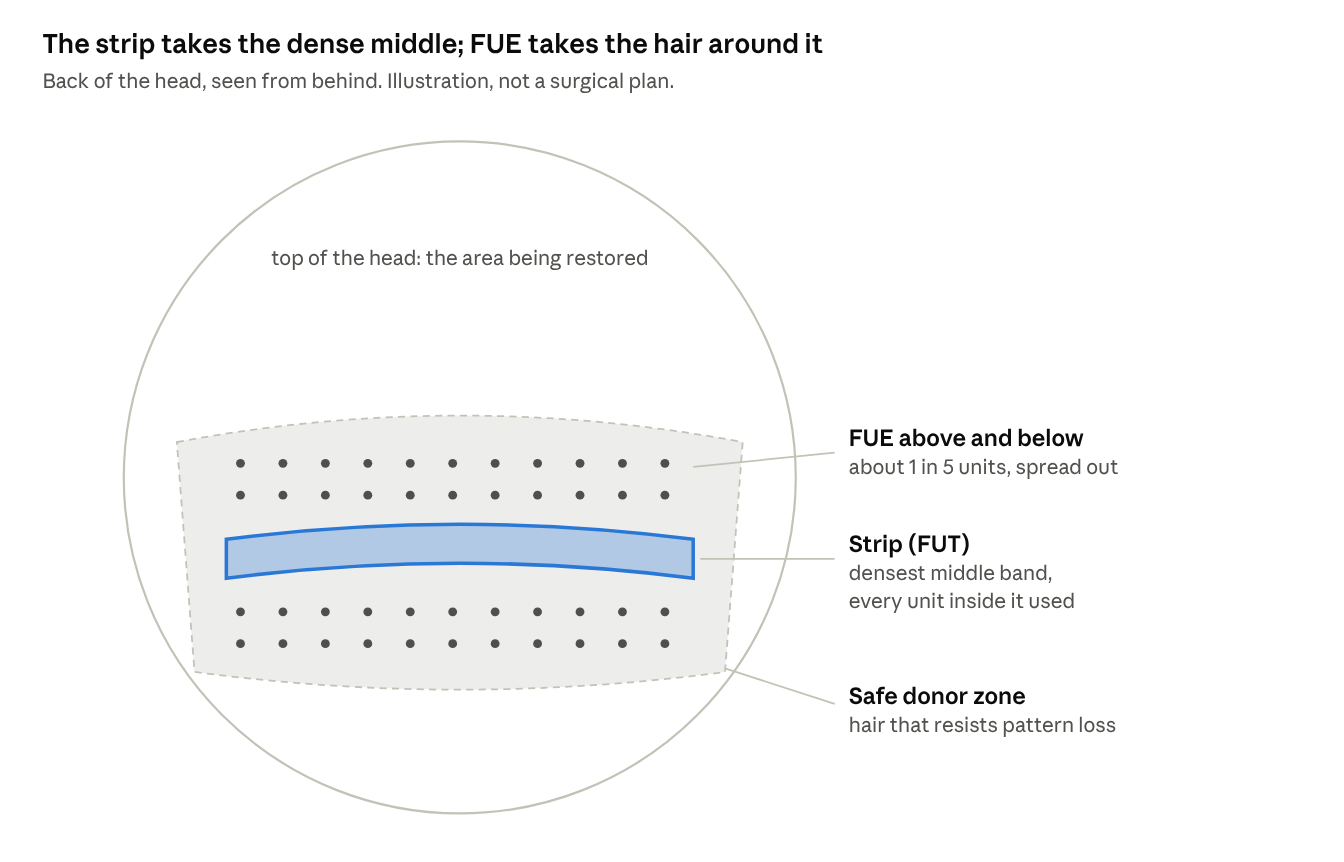
The two harvesting methods draw on the account differently. FUE takes single follicular units through small punches. To keep the donor looking even, it can only take about one in five follicles from any given area [1]. Many surgeons cap a single session at 10% to 20% of the units present [6].
Strip surgery (FUT) removes a narrow band of scalp and uses every unit inside it, leaving one fine line scar [1]. It is limited by how much the scalp can stretch to close, not by spacing. Combining the two gets more from one lifetime of donor hair, which combined FUT and FUE explains [1, 8].
Overspending usually happens in very large sessions. Donor over-harvesting is increasingly reported in sessions above 3,000 to 4,000 grafts, often in patients who asked for large numbers despite a thin donor and who underestimated where their hair loss was heading [6].
Where the grafts go matters too. Spending them on the crown alone, in a man whose front is still to go, uses up the donor early and can leave an island of hair surrounded by later loss [2].
What this means if you are planning a transplant
- Ask for the lifetime picture, not just this session. How many grafts you need now, and how many you may need later, are different questions. How many grafts do I need? covers both.
- If you are young, expect caution. Loss that starts early often goes further, and nobody can see the end point at 22. What age should I have a hair transplant? explains why.
- Slowing your hair loss protects the balance. Every follicle you keep on top is one you never have to replace. Will my hair loss get worse? explains how progression is judged.
- A second session is normal planning, not failure. Holding grafts back now is what makes it possible. What if I need a second hair transplant? walks through it.
For clinicians and technicians
- Measure before you promise. Record follicular unit density and hairs per unit at several points across the donor, with dermoscopy and baseline photographs. Below 60 units per square centimetre is generally treated as low density [5].
- Plan for the Norwood you cannot see yet. Patients with aggressive early loss may reach Norwood 5 to 6 by 30. A low, flat hairline or heavy spending on the vertex in these patients jeopardises their future [5].
- Respect per-session limits. No standard extraction limit is agreed, but many authors recommend 10% to 20% of baseline unit density per session, spread evenly and tapered at the margins [6].
- Avoid vertex-only grafting in progressive loss. It uses donor early and risks an isolated island as the surrounding hair goes [2].
- Think lifetime yield. Combining strip and FUE optimises total graft yield while limiting the risk of depletion [8]. Document the plan in grafts and hairs per graft, so later sessions start from known numbers.
Teach the donor as a budget, not a supply. Patients who see it that way choose plans that still look right in 20 years.
Teach it back
If this article worked, you can now answer these without scrolling up.
- Why can the donor area never be topped up?
- Why is spending most of the donor on a 23-year-old's hairline risky?
- If only about half the hair in the safe zone can be taken, what is the other half doing?
References
- Kumaresan M, Mysore V. Controversies in hair transplantation. J Cutan Aesthet Surg. 2018;11(4):173-81. PubMed 30886470
- Goldin J, Zito PM, Raggio BS. Hair transplantation. In: StatPearls. Treasure Island (FL): StatPearls Publishing; updated 2 Aug 2025. PubMed 31613520
- Norwood OT. Male pattern baldness: classification and incidence. South Med J. 1975;68(11):1359-65. PubMed 1188424
- Jimenez F, Ruifernández JM. Distribution of human hair in follicular units. A mathematical model for estimating the donor size in follicular unit transplantation. Dermatol Surg. 1999;25(4):294-8. PubMed 10417585
- True RH. Is every patient of hair loss a candidate for hair transplant? Deciding surgical candidacy in pattern hair loss. Indian J Plast Surg. 2021;54(4):435-40. PubMed 34984081
- Romera de Blas C, Vega Díez D, Ricart Vayá JM, Gómez Zubiaur A. Complications in follicular unit excision hair transplantation: current evidence and practical approaches. Front Med (Lausanne). 2026;13:1750989. PubMed 41709896
- Krishnamurthy R, Jaganathan BK, Rangaswamy R, Jeganathan C. A novel method of intraoperative calculation in follicular unit transplantation: 'the sequential strip and FUE method'. Aesthetic Plast Surg. 2024;48(3):297-303. PubMed 36928376
- Keene SA, Susacasa A, Miranda P, Radwanski H. Follicular unit excision-linear ellipse donor harvesting technique: combining standard follicular unit excision with follicular unit excision inside a linear strip (modified linear strip excision) to optimize graft yield. Facial Plast Surg. 2024;40(2):205-13. PubMed 37879352
Medical note: This article is general information, not medical advice. Whether a hair transplant or any treatment suits you is confirmed only at a consultation with a GMC-registered doctor. Results vary from person to person.