Follicular units: how hair comes packaged
 Drafted by the Fix My Hair editorial team · Clinically reviewed by Dr Hisham Band · GMC No. 7550130 · Last reviewed 21 Oct 2026
In one breath: Scalp hair grows in tiny natural bunches of one to four hairs, called follicular units. A surgeon moves whole bunches, not single hairs, so a graft count and a hair count are different numbers. Most grafts hold about two hairs, which is why 2,000 grafts usually means somewhere around 3,500 to 4,500 hairs.
Look closely at a parting
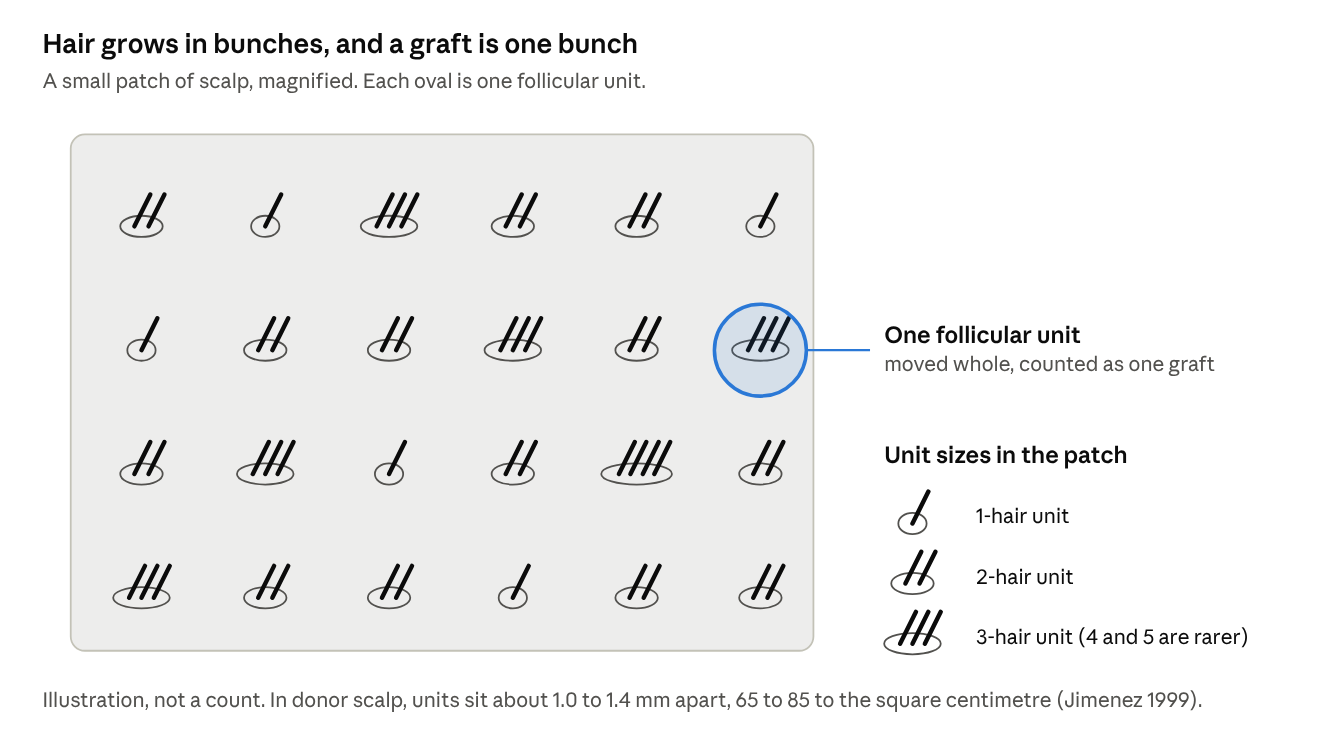
Part your hair and look at the scalp through a magnifying glass. The hairs do not come out one by one at even spacing. They come out in small clusters: a single here, a pair there, a three a little further on.
In 1984 JT Headington cut scalp biopsies crosswise and counted what he saw [1]. Hair, he noted, grows in natural groups of one to five, with fours and fives the rarer sizes [2]. Each group grows as a discrete unit of skin and follicles [3].
A follicular unit is a natural group of one to four hairs, occasionally five, that grows from the scalp as a single unit. Modern hair transplants move these units whole, because placing hair in the groups nature already uses is what makes a result look natural [4].
Grafts are not hairs
Because units are moved whole, clinics count grafts, not hairs. One graft is one unit. A graft can hold one hair or three, so the hair count depends on your own mix.
In one study of 42 patients, grafts averaged 2.15 hairs with one FUE method and 2.23 with another [5]. Across people, the donor area at the back holds 65 to 85 units and 124 to 200 hairs per square centimetre, so the average number of hairs in each unit varies from person to person [6].
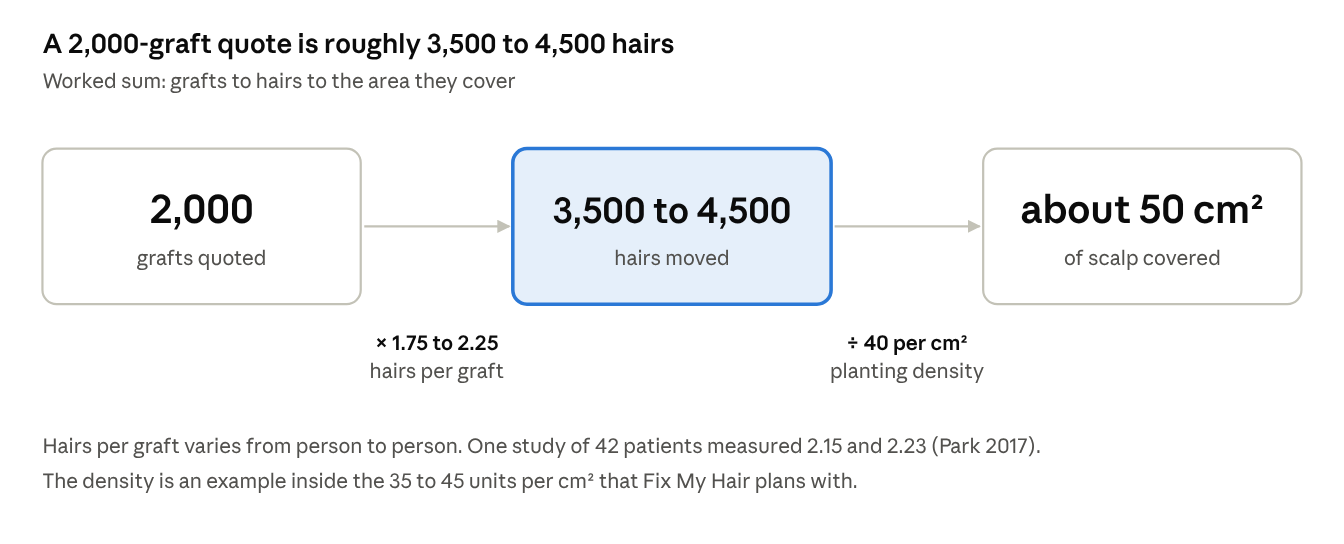
That range is why a quote needs two numbers. At 1.75 hairs a graft, 2,000 grafts is 3,500 hairs. At 2.25, it is 4,500 hairs. Same quote, a thousand hairs apart.
How density is worked out
Density is counted two ways: units per square centimetre and hairs per square centimetre. Both are measured in the donor area before surgery, because they set how many grafts can be taken and how much each one is worth.
In the area being restored, grafts are not packed back at their natural density. Fix My Hair plans most restored areas at around 35 to 45 units per square centimetre. Packing much tighter, beyond about 45 to 50 per square centimetre, is linked with more complications [7].
So the coverage sum is simple division. At 40 grafts per square centimetre, 2,000 grafts covers about 50 square centimetres.
The picture, and where it breaks
Think of eggs sold in boxes of one, two or three. A shop quotes you boxes. A recipe needs eggs. To compare two shops you need to know how full the boxes are.
The picture breaks in three places. Egg boxes come in fixed sizes, but your mix of units is your own, so nobody can promise an exact hair count before surgery. Eggs are all the same size, but hairs are not: thick or curly hair covers more scalp per graft than fine, straight hair. And every egg arrives, whereas not every graft grows. Survival is high in good hands, but not perfect. One series of 273 large FUE sessions reported 93.5% to 96.6% [8].
What is actually happening
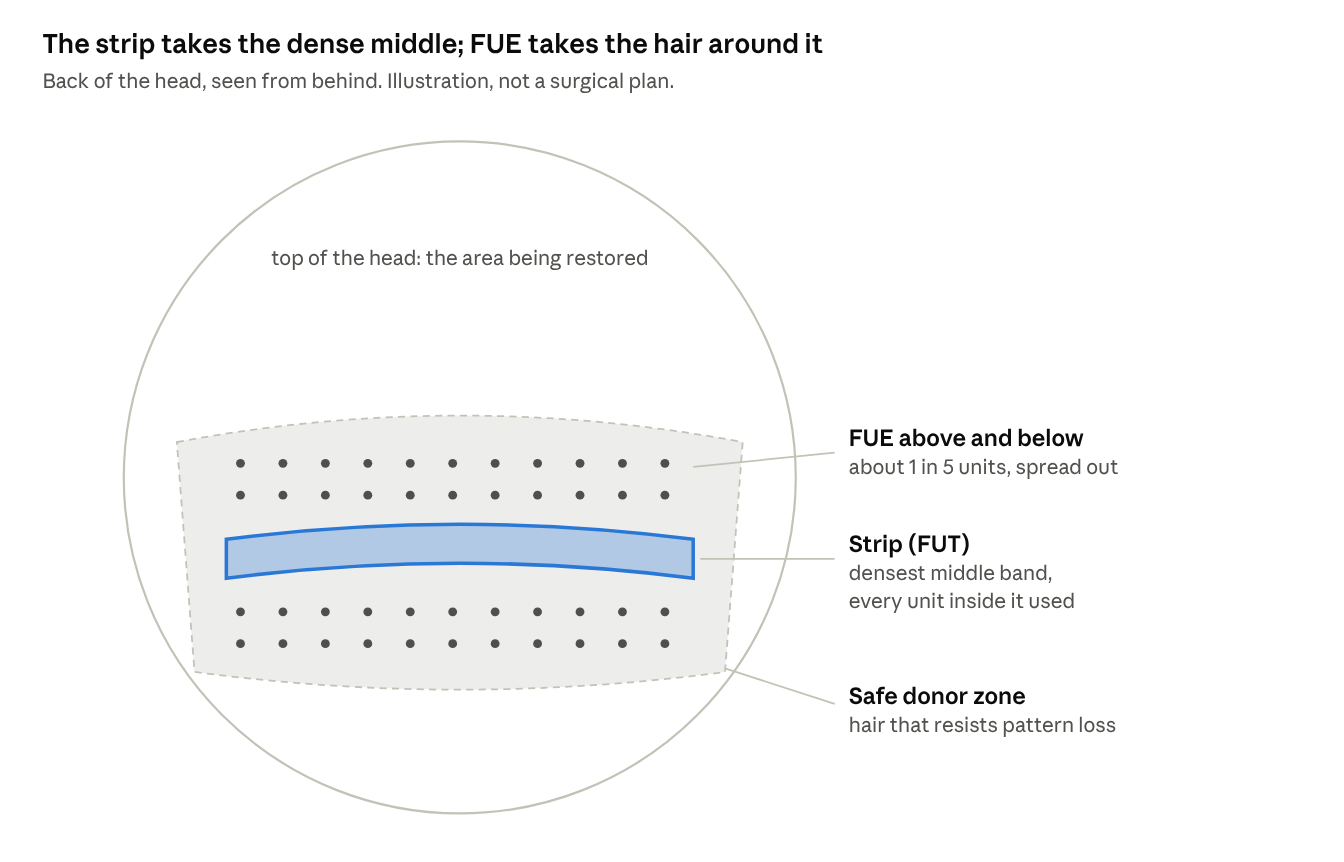
In donor scalp, follicular units sit about 1.0 to 1.4 mm apart [6]. That spacing is why the tools are sized as they are. FUE, introduced in its modern form in 2002, used 1 mm punches to cut around one unit at a time and lift it out [9]. In strip surgery the strip is cut into individual units under a microscope, which keeps each unit intact [3].
The units then go into the recipient area in a planned pattern. Unit size is part of that plan: single-hair units read softer than threes, which matters most at the hairline.
What this means if you are planning a transplant
- Ask for grafts and hairs. A graft count alone hides the difference between a mix of ones and a mix of threes. How many grafts do I need? explains how the number is set.
- Compare quotes like for like. Fix My Hair prices FUE by graft count, in three bands. Pricing sets them out, so two quotes can be lined up.
- Your hair type changes the sum. Thicker, wavier or curlier hair covers more per graft. FUE vs FUT vs DHI covers how technique choice interacts with hair type.
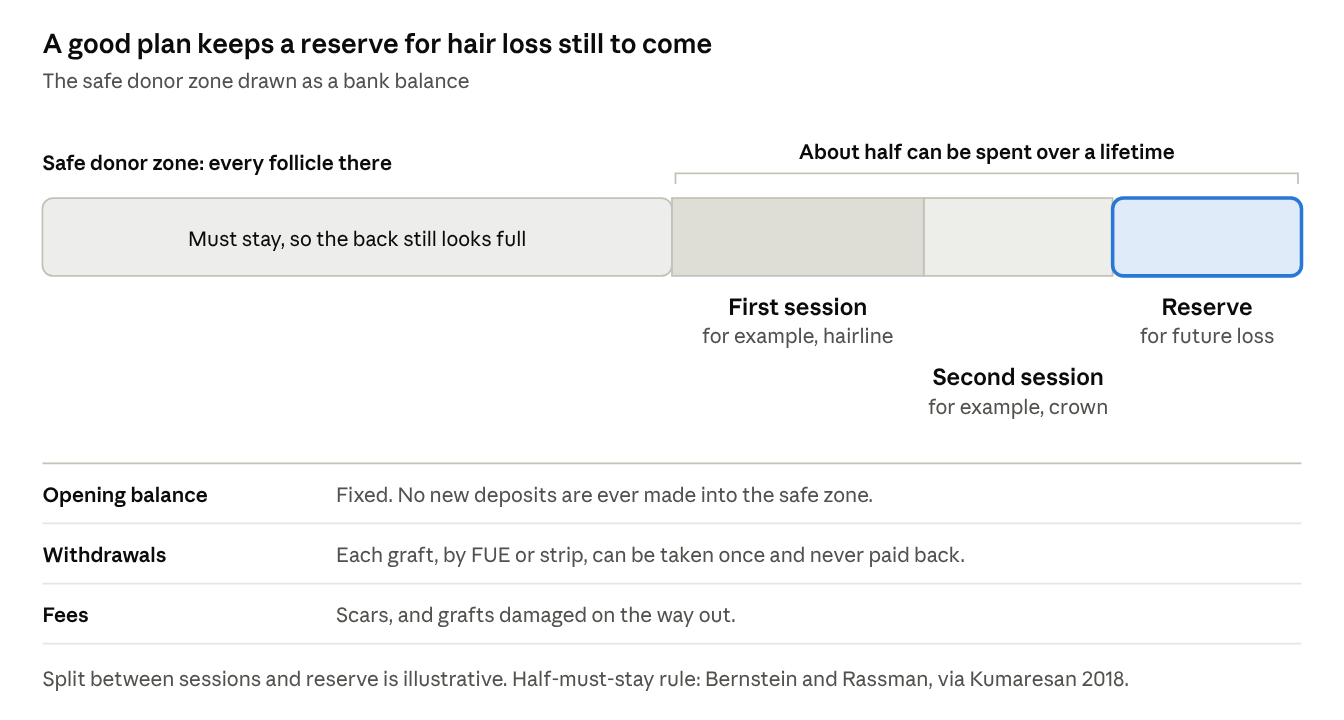
- More grafts is not always better. Your donor supply is finite, and a second session may be needed later. What if I need a second hair transplant? explains how that is planned.
For clinicians and technicians
- Measure both densities at the donor. Units per square centimetre and hairs per square centimetre, at several points. The reference range for occipital scalp is 65 to 85 units and 124 to 200 hairs per square centimetre [6]. Below 60 units per square centimetre is generally treated as low donor density [10].
- Report hairs per graft, not just grafts. It varies with harvest method as well as the patient: pretrimmed and direct non-shaven FUE gave 2.23 and 2.15 hairs per graft in the same patients [5]. Splitting units raises a graft count without adding hair, so a hairs-per-graft figure keeps the count honest.
- Keep units intact. Microscopic dissection that preserves the unit is the basis of follicular unit transplantation [3]. Trim excess tissue, but do not divide multi-hair units to hit a number.
- Respect recipient density limits. Dense packing above about 45 to 50 units per square centimetre is a reported risk factor for complications [7]. Plan density by zone rather than one figure across the scalp.
Teach this as "a graft is a bunch, not a hair". Patients who understand it ask better questions and are harder to mislead with large graft numbers.
Teach it back
If this article worked, you can now answer these without scrolling up.
- A clinic quotes 2,500 grafts. Roughly how many hairs is that, and why can nobody tell you exactly before surgery?
- Why do surgeons move whole follicular units rather than single hairs?
- If grafts are placed at 40 per square centimetre, about how much scalp do 2,000 grafts cover?
References
- Headington JT. Transverse microscopic anatomy of the human scalp. A basis for a morphometric approach to disorders of the hair follicle. Arch Dermatol. 1984;120(4):449-56. PubMed 6703750
- Khanna M. Hair transplant with strip harvest: indications, contraindications, and technique. Indian J Plast Surg. 2021;54(4):451-5. PubMed 34984084
- Bernstein RM, Rassman WR. Follicular unit transplantation: 2005. Dermatol Clin. 2005;23(3):393-414. PubMed 16039422
- Bernstein RM, Rassman WR. The aesthetics of follicular transplantation. Dermatol Surg. 1997;23(9):785-99. PubMed 9311373
- Park JH, You SH. Pretrimmed versus direct nonshaven follicular unit extraction. Plast Reconstr Surg Glob Open. 2017;5(3):e1261. PubMed 28458975
- Jimenez F, Ruifernández JM. Distribution of human hair in follicular units. A mathematical model for estimating the donor size in follicular unit transplantation. Dermatol Surg. 1999;25(4):294-8. PubMed 10417585
- Romera de Blas C, Vega Díez D, Ricart Vayá JM, Gómez Zubiaur A. Complications in follicular unit excision hair transplantation: current evidence and practical approaches. Front Med (Lausanne). 2026;13:1750989. PubMed 41709896
- Li KT, Qu Q, Fan ZX, et al. Clinical experience on follicular unit extraction megasession for severe androgenetic alopecia. J Cosmet Dermatol. 2020;19(6):1481-6. PubMed 31529675
- Rassman WR, Bernstein RM, McClellan R, et al. Follicular unit extraction: minimally invasive surgery for hair transplantation. Dermatol Surg. 2002;28(8):720-8. PubMed 12174065
- True RH. Is every patient of hair loss a candidate for hair transplant? Deciding surgical candidacy in pattern hair loss. Indian J Plast Surg. 2021;54(4):435-40. PubMed 34984081
Medical note: This article is general information, not medical advice. Whether a hair transplant or any treatment suits you is confirmed only at a consultation with a GMC-registered doctor. Results vary from person to person.