Your hair grows in shifts: the follicle cycle explained
 Drafted by the Fix My Hair editorial team · Clinically reviewed by Dr Hisham Band · GMC No. 7550130 · Last reviewed 21 Oct 2026
In one breath: Every hair follicle works in shifts. It grows a hair for years, winds down for about two weeks, rests for two to three months, then lets the old hair go and starts again. Because each follicle keeps its own hours, you lose hair every day without getting thinner, and transplanted hairs fall out a few weeks after surgery before growing back.
Your scalp is a factory that never closes
An average scalp carries about 100,000 hairs [1]. Each one grows from its own follicle, a small pocket in the skin. Think of every follicle as a tiny factory with one product: a single hair.
The factory does not run nonstop. It works a long shift, winds down, rests, clears out the finished product and starts again. The hair growth cycle is that repeating sequence of growth (anagen), regression (catagen), rest (telogen) and shedding (exogen), and every follicle you have goes through it.
The reason your head stays covered is that the factories do not keep the same hours. At any moment most are mid-shift and only a small share are resting. One review puts the resting share of scalp hair at about 9% [1].
The four shifts
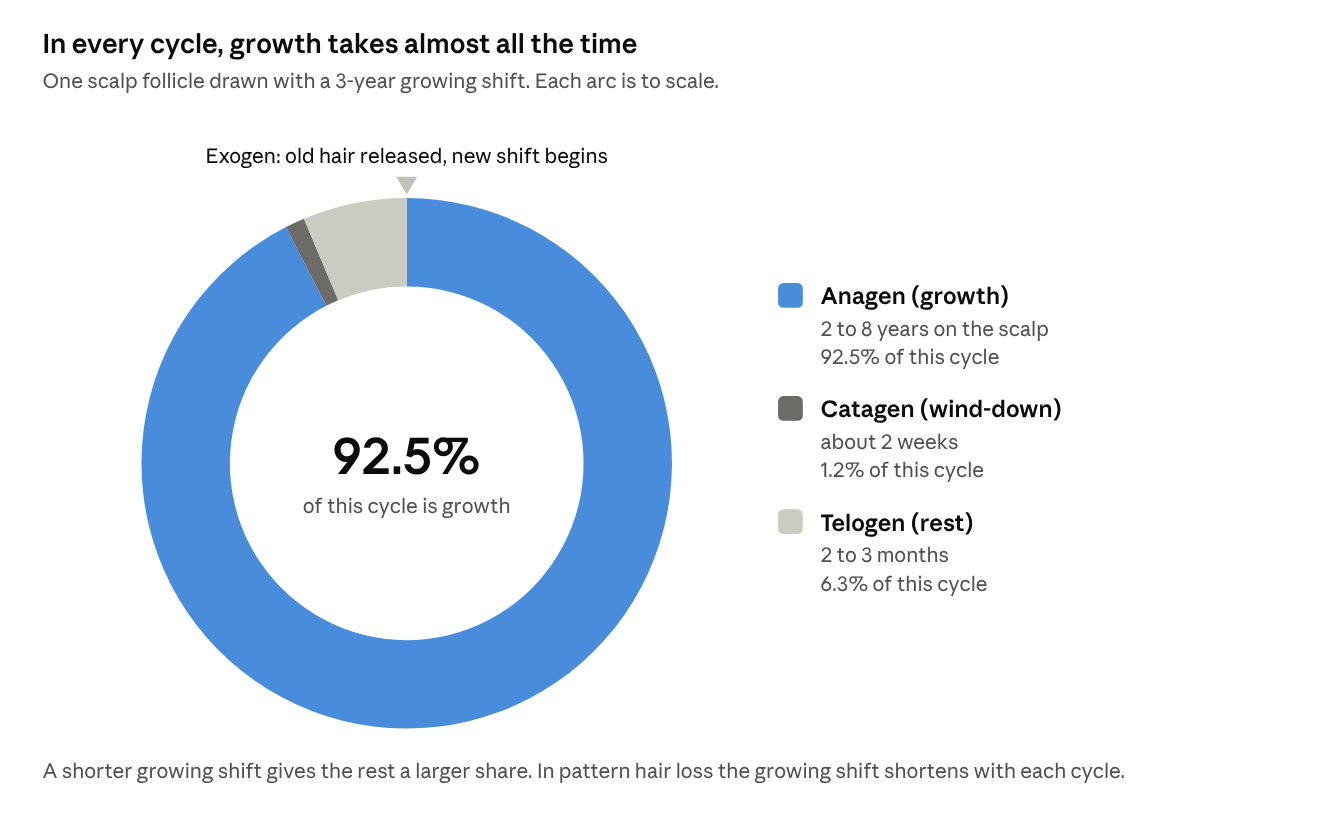
Anagen, the long day shift. The follicle builds a hair continuously. On the scalp this shift lasts about two to eight years [1].
Catagen, the wind-down. About two weeks. The lower part of the follicle shrinks and pulls away from the cells at its base [1].
Telogen, the rest. About two to three months. The finished hair stays anchored but no longer grows [1].
Exogen, the clear-out. The old hair is released, often as a new one starts beneath it. Work in mice in 2002 showed that shedding is its own controlled step, not just a loose hair dropping out [2].
Why 100 hairs on your pillow is normal
Here is a rough check using the review's own figures. If about 9% of 100,000 scalp hairs are resting, that is around 9,000 hairs. Each rests for two to three months, so roughly 60 to 90 days. Spread 9,000 hairs over that time and you lose somewhere between 100 and 150 a day.
That matches what the review describes as normal: 100 to 150 resting hairs shed a day [1]. The hairs in the plughole are mostly the end of a rest, not the start of baldness. What matters is a change: shedding that suddenly jumps, or hair that grows back finer than before.
The picture, and where it breaks
The factory picture works well for timing. It explains why shedding is constant, why it is spread out, and why a rest has to end before a new hair appears.
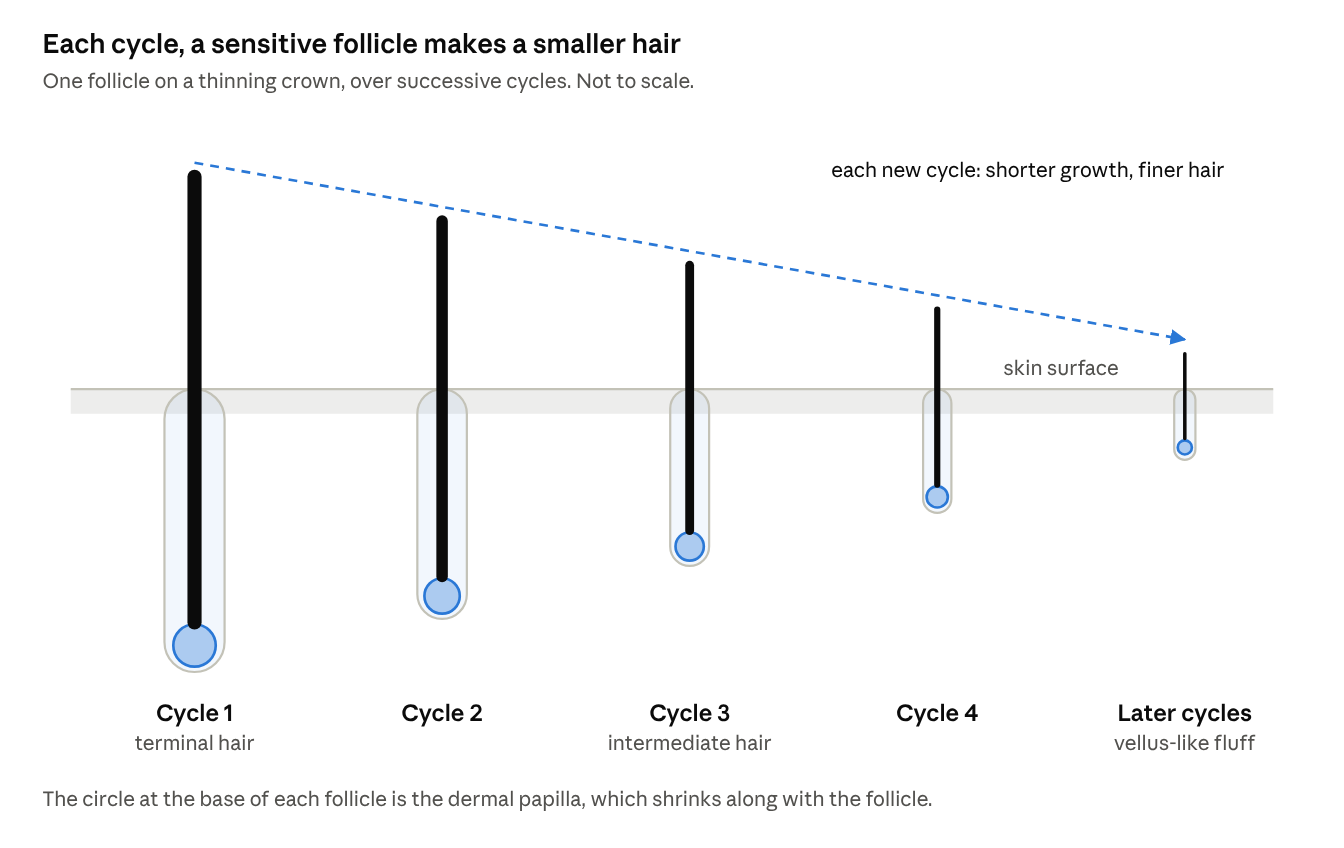
It breaks in three places. First, a real factory does not shrink its own product. In pattern hair loss each new growing shift gets shorter and the hair it makes gets finer, so the factory slowly downsizes [3]. That is miniaturisation, and it has its own article.
Second, a closed factory stays closed. A follicle can sit empty for months after its hair falls and still restart. Researchers who photographed the same patches of scalp for years called this empty stage kenogen [4].
Third, the shifts are not on a fixed clock. Two to eight years is a wide range, and it differs between people and between parts of the body [1].
What is actually happening inside the follicle
Each follicle has a few parts that matter for this story. Near the top sits the sebaceous gland, which oils the hair. Just below it, the arrector pili muscle attaches to a region called the bulge, where the follicle keeps the reserve cells that restart each growing shift [5].
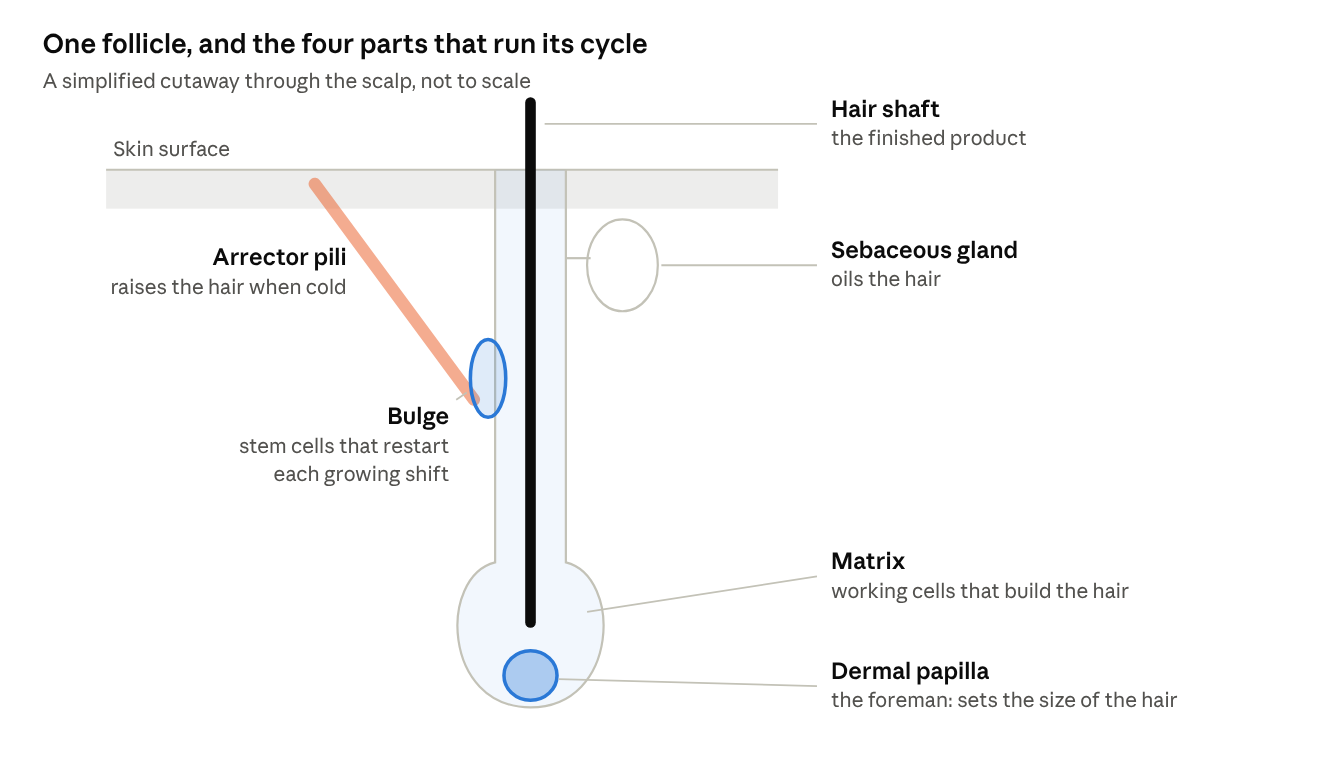
At the very bottom sits the dermal papilla, a small cluster of cells that acts like the factory's foreman. It controls how many working cells the follicle has in its base, and so how big a hair it makes [1].
During catagen the lower follicle breaks down and the dermal papilla moves up towards the bulge. If it fails to get there, the follicle stops cycling and that hair is lost for good [1]. A new shift starts when signals between the papilla and the bulge wake those reserve cells again.
The length of the growing shift sets how long a hair can get. Scalp follicles grow for two to eight years. Eyebrow follicles grow for only two to three months [1]. That is why your eyebrows stop short without ever being cut, and why scalp hair can reach your waist.
What this means after a hair transplant
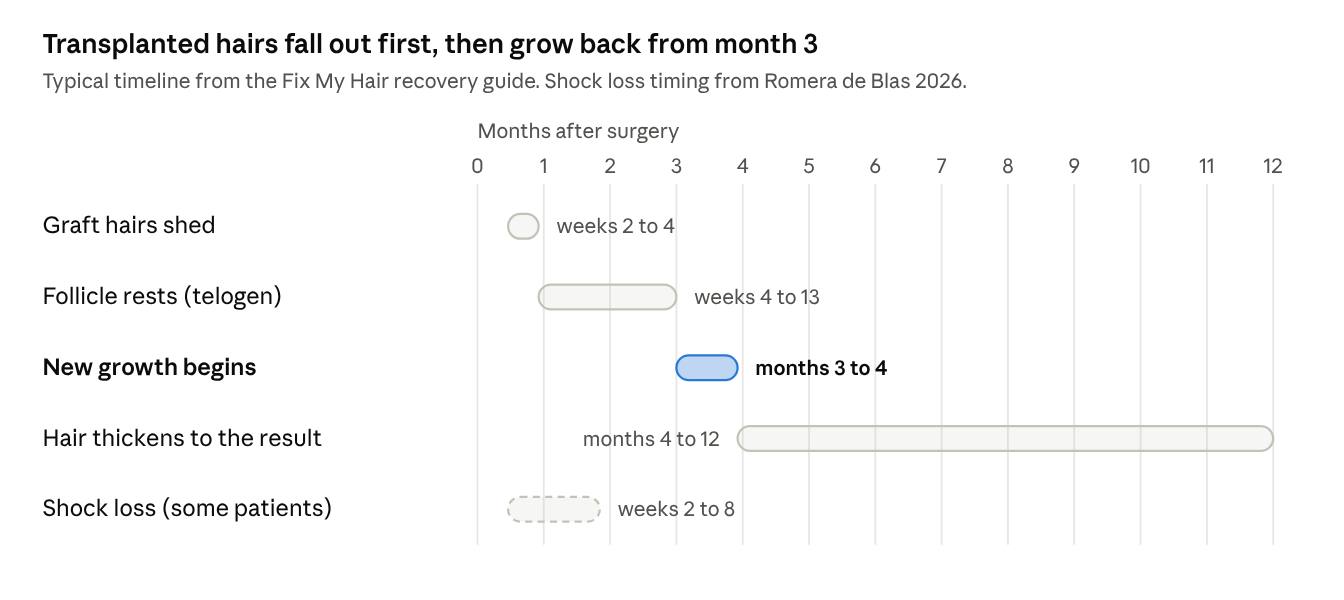
Moving a follicle is a shock to the factory. The hair it was making usually falls out within three to four weeks of surgery [6]. The follicle itself stays alive in the skin. It rests, then starts a new growing shift.
On the timeline Fix My Hair gives patients, the transplanted hairs shed from about weeks 2 to 4, new growth starts around months 3 to 4, and the result thickens up to months 9 to 12. Sometimes the existing hair around the grafts also sheds for a while. That is called shock loss. It usually appears 2 to 8 weeks after surgery and starts to regrow from around month 3 [7].
What this means if you are planning a transplant
- Daily shedding is not a diagnosis. Losing hair every day is how the cycle works. A sudden rise, or hair coming back finer, is worth a proper look. Why am I losing my hair? walks through the common causes.
- A shed can arrive late. Because the rest lasts two to three months, anything that pushes many follicles into rest at once shows up as shedding weeks later. Can stress cause hair loss? explains one common trigger.
- Expect your new hairs to fall out. It is the cycle restarting, not the grafts failing. The shedding phase: what nobody tells you covers what it looks like.
- Judge the result at a year, not at twelve weeks. Most of the visible change comes after month 4. Your month-by-month recovery guide sets out what to expect and when.
For clinicians and technicians
- Count follicles, not just hairs. Phototrichogram work describes kenogen, an empty follicle after the telogen hair falls. In 10 men followed for 14 years it lasted about 4 months, up to about 7, and it was longer and more frequent in androgenetic alopecia [4]. A visible hair count undercounts living follicles, in the donor and after surgery.
- The papilla sets the size. The dermal papilla controls matrix cell number and so hair calibre [1]. One proposal is that miniaturisation follows a fall in papilla cell number, and that it can happen in large steps rather than slowly over many cycles [8].
- Anagen length is site-specific. Scalp anagen runs years and eyebrow anagen runs months [1]. Scalp grafts placed in the brow keep scalp behaviour and need trimming for life, which is donor dominance applied to length.
- Separate graft shedding from shock loss. Graft hairs usually shed by weeks 3 to 4 [6]. Shock loss of native hair is reported in 0.15% to 15% of cases, with female sex a major risk factor [7]. Warn women in particular before surgery.
- Know which findings come from mice. The bulge cell work and the exogen work were done in mice [2, 5]. The human timing of exogen is less well mapped, so teach it as a step, not a stopwatch.
Teach the cycle as "long growth, short wind-down, rest, release", with the durations as ranges. Patients who know the ranges handle the post-operative shed far better than patients given a single date.
Teach it back
If this article worked, you can now answer these without scrolling up.
- About 9% of your 100,000 scalp hairs are resting and each rest lasts two to three months. Roughly how many hairs would you expect to lose a day?
- Why can scalp hair grow to your waist when your eyebrows stop short without being cut?
- Your transplanted hairs fall out in week 3. Why is that not a sign the surgery has failed?
References
- Natarelli N, Gahoonia N, Sivamani RK. Integrative and mechanistic approach to the hair growth cycle and hair loss. J Clin Med. 2023;12(3):893. PubMed 36769541
- Milner Y, Sudnik J, Filippi M, et al. Exogen, shedding phase of the hair growth cycle: characterization of a mouse model. J Invest Dermatol. 2002;119(3):639-44. PubMed 12230507
- Trüeb RM. Understanding pattern hair loss: hair biology impacted by genes, androgens, prostaglandins and epigenetic factors. Indian J Plast Surg. 2021;54(4):385-92. PubMed 34984074
- Rebora A, Guarrera M. Kenogen. A new phase of the hair cycle? Dermatology. 2002;205(2):108-10. PubMed 12218222
- Cotsarelis G, Sun TT, Lavker RM. Label-retaining cells reside in the bulge area of pilosebaceous unit: implications for follicular stem cells, hair cycle, and skin carcinogenesis. Cell. 1990;61(7):1329-37. PubMed 2364430
- Garg AK, Garg S. Complications of hair transplant procedures: causes and management. Indian J Plast Surg. 2021;54(4):477-82. PubMed 34984088
- Romera de Blas C, Vega Díez D, Ricart Vayá JM, Gómez Zubiaur A. Complications in follicular unit excision hair transplantation: current evidence and practical approaches. Front Med (Lausanne). 2026;13:1750989. PubMed 41709896
- Whiting DA. Possible mechanisms of miniaturization during androgenetic alopecia or pattern hair loss. J Am Acad Dermatol. 2001;45(3 Suppl):S81-6. PubMed 11511857
Medical note: This article is general information, not medical advice. Whether a hair transplant or any treatment suits you is confirmed only at a consultation with a GMC-registered doctor. Results vary from person to person.