Miniaturisation: how DHT shrinks a hair one cycle at a time
 Drafted by the Fix My Hair editorial team · Clinically reviewed by Dr Hisham Band · GMC No. 7550130 · Last reviewed 21 Oct 2026
In one breath: Pattern hair loss is less about hair falling out and more about hair shrinking. A hormone called DHT tells sensitive follicles to grow a shorter-lived, finer hair each cycle, until what grows is barely visible fluff. Follicles that are still shrinking have more to save than follicles that have stopped, which is why acting early keeps more hair.
A thinning crown is not an empty crown
Look at a thinning crown up close and you will usually see plenty of hairs. They are just small. Fine, short, pale hairs that let the scalp show through where thick hair once covered it.
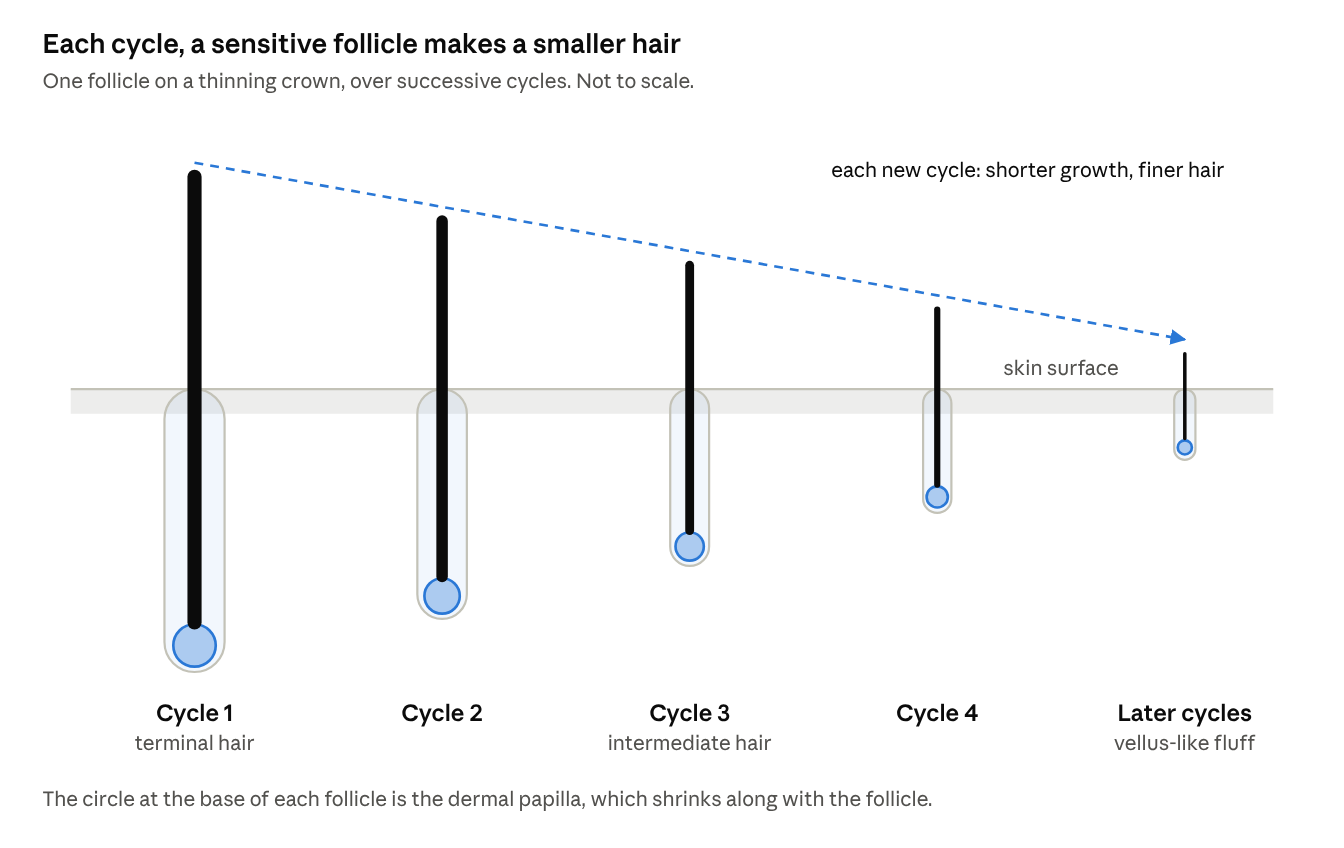
Miniaturisation is the step-by-step shrinking of a hair follicle under the hormone DHT, so that each new hair it grows is finer and shorter than the last. In pattern hair loss, each growing phase gets shorter than the one before and the follicle itself gets smaller [1]. More hairs shed, and the ones that replace them cover the scalp poorly [1].
The key, the lock and the door
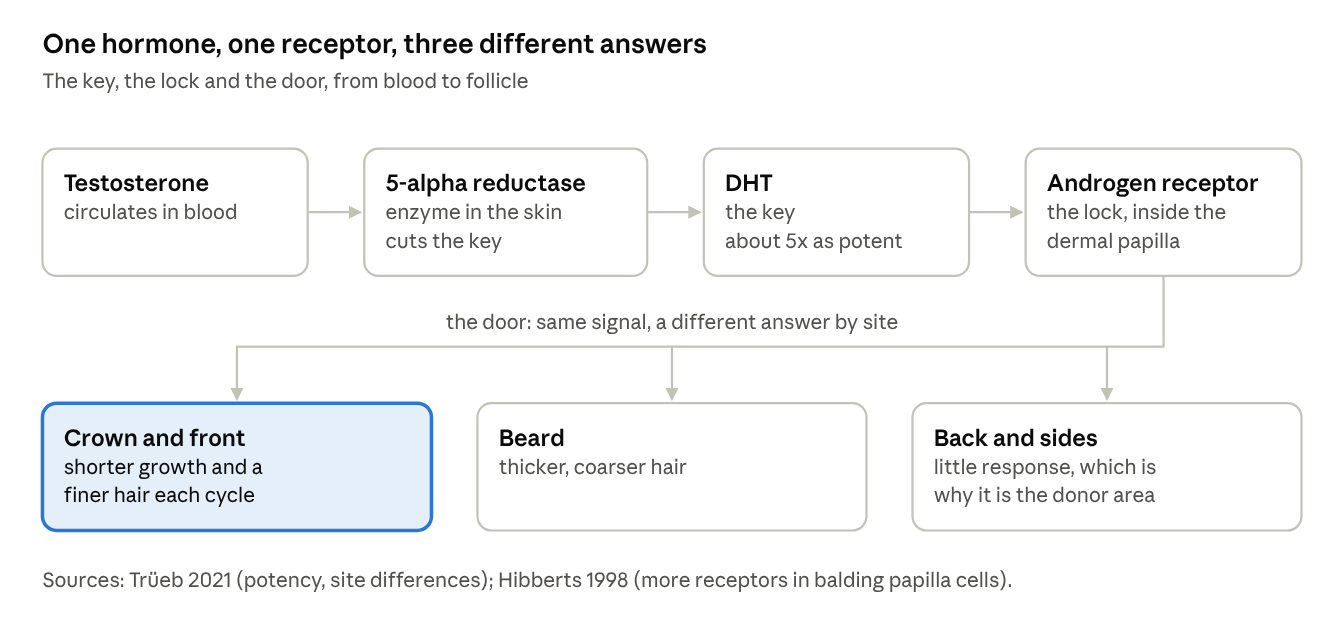
Testosterone circulates in the blood of men and, at lower levels, women. In the skin, an enzyme called 5-alpha reductase converts some of it into dihydrotestosterone, or DHT [1]. Think of the enzyme as a key cutter and DHT as the finished key.
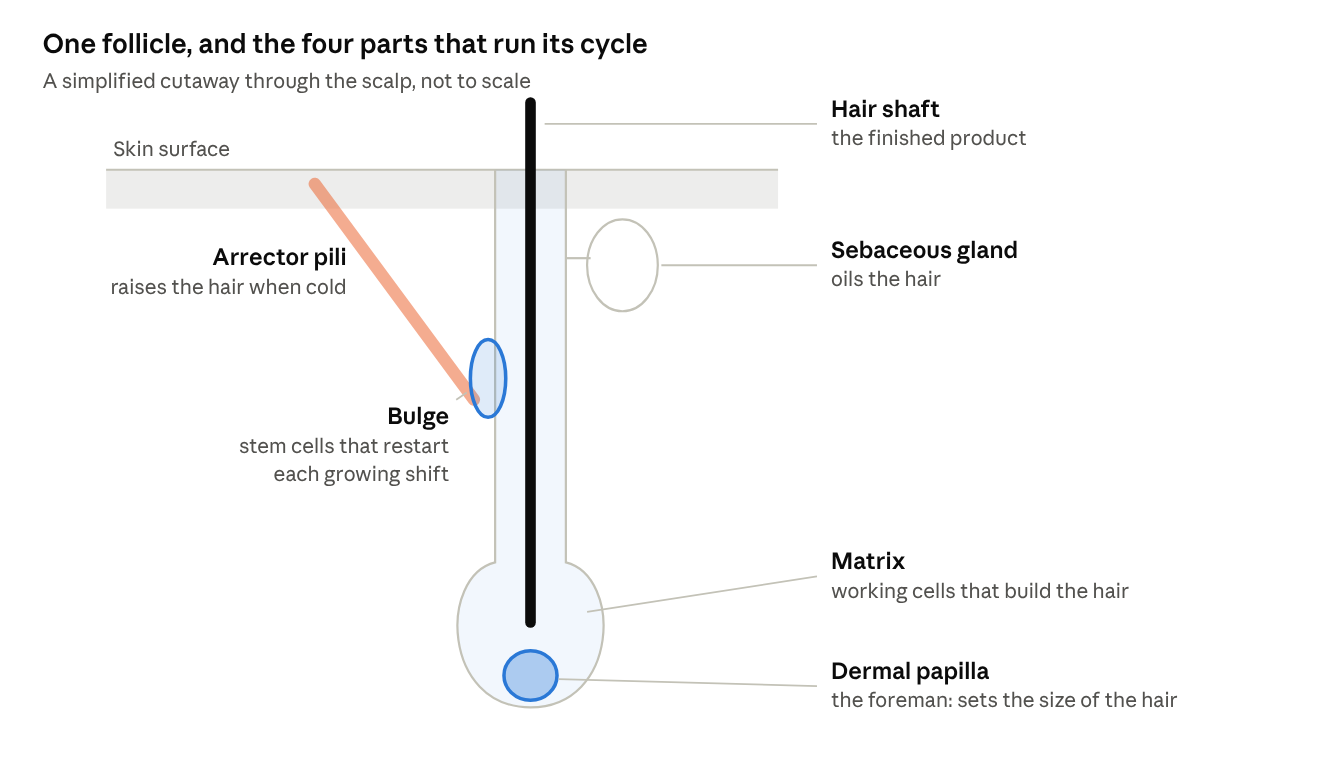
The lock is a protein called the androgen receptor, found inside the cells of the dermal papilla at the base of the follicle. DHT fits it about five times more strongly than testosterone does [1]. Papilla cells from balding scalp carry more of these receptors than papilla cells from scalp that is not balding [2].
The door is what happens when the key turns. On the crown and front, the follicle shortens its growing phase and builds a smaller hair. Same key, same lock, but the door opens onto a different room depending on where the follicle sits.
Two natural experiments show the key matters. James Hamilton studied men who had been castrated, and so lacked testicular hormones, and his observations established that male hormones are needed for pattern baldness [1]. And men born without a working type 2 version of the enzyme, a condition first described in 1974, make very little DHT and do not develop pattern hair loss [1, 3].
The picture, and where it breaks
The key-and-lock picture explains why blocking the key cutter, or keeping the key off the lock, can slow the shrinking. It also explains why the hormone level in the blood is not the whole story: men with ordinary testosterone levels go bald, and men with high levels may not.
It breaks in three places. First, the same key opens doors that lead to opposite rooms. On the chin, androgens build a thicker beard. On the crown, they shrink the hair. At the back and sides, the door barely moves [1].
Second, the locks are not all the same. The genes for the 5-alpha reductase enzymes do not track with who inherits pattern hair loss, but variations in the androgen receptor gene do [1]. Sensitivity sits mostly in the lock, not in how many keys are cut.
Third, the staircase is not always a gentle slope. One proposal is that a follicle can drop in large steps, and that the step can reverse within a single cycle if the signal is removed [4].
What is actually happening
The dermal papilla sets the size of the hair by controlling how many working cells the follicle has in its base [5]. When DHT acts on a sensitive papilla, the papilla gets smaller. A smaller papilla runs a smaller follicle, and a smaller follicle makes a thinner hair [4].
The growing phase shortens at the same time [1]. A hair that grows for months instead of years never gets long. So miniaturised hairs are both finer and shorter, which is why a thinning area looks see-through long before it looks bald.
The resting gaps also lengthen. After a miniaturised hair falls out, the follicle can sit empty for months before the next one starts, a stage called kenogen, and those gaps are longer and more common in pattern hair loss [6].
Why early action keeps more hair
A follicle that is still making an intermediate hair is still cycling. Its papilla is smaller but present. Follicles in that state have been shown to grow back to a larger size within one cycle when DHT is lowered [4].
A follicle that has stopped cycling is a different case. If the papilla fails to make its trip back up the follicle at the end of a cycle, the follicle stops and the hair is lost for good [5]. Nobody can yet say exactly when a shrinking follicle crosses that line, and the evidence on rescuing hairs that have been fluff for years is thin.
So the honest advice is simple: the earlier the shrinking is measured and discussed with a doctor, the more follicles are still in the range where they can respond. Treatments that act on this pathway are prescription matters, decided after an assessment, not bought on impulse.
What this means if you are planning a transplant
- Thinning is measured, not guessed. A magnified look at the scalp shows the mix of thick and fine hairs long before the mirror does. Hair loss assessment explains what is checked.
- Start the conversation early. The sooner miniaturisation is spotted, the more options remain. Why am I losing my hair? covers the common causes.
- A transplant does not stop miniaturisation. Moved hairs come from resistant follicles, but your own hair on top keeps its sensitivity. Will my hair loss get worse? explains how that is judged.
- Your Norwood stage is a pattern, not a process. It shows where hair has thinned, not how fast it is shrinking. The Norwood scale explained shows the stages.
For clinicians and technicians
- Know the two enzymes. Type 1 5-alpha reductase is expressed in skin from puberty with no qualitative difference between balding and non-balding scalp. Men deficient in type 2 show less temporal recession, which points to type 2 as an initiating factor [7]. Frontal follicles in pattern hair loss show more 5-alpha reductase activity than occipital follicles, and occipital follicles more aromatase [1].
- Sensitivity lives in the receptor. Balding papilla cells carry more androgen receptors [2], and androgen receptor gene variants, not 5-alpha reductase genes, associate with male pattern hair loss [1].
- Look for diameter diversity. Variation in hair calibre is the main and most accurate clinical sign of miniaturisation [8]. Record it at several points, including the donor, where it changes the surgical plan.
- Do not write off intermediate hairs. The large-step model, with histology from patients responding to finasteride, suggests miniaturisation can reverse within one cycle [4]. That supports measuring and managing the native hair alongside any surgical plan.
- Expect empty follicles. Kenogen is longer and more frequent in androgenetic alopecia [6], so a hair count in a thinning area understates the follicles present.
Teach miniaturisation as "shrinking, not falling". Patients who see their fine hairs as follicles still in play are more likely to act early, and less likely to see a transplant as a fix for the hair it leaves untouched.
Teach it back
If this article worked, you can now answer these without scrolling up.
- Why is a thinning crown usually not empty skin?
- Men born without a working type 2 enzyme do not develop pattern hair loss. What does that tell you about which hormone does the damage?
- Why does acting while hairs are still shrinking keep more hair than waiting until they have gone?
References
- Trüeb RM. Understanding pattern hair loss: hair biology impacted by genes, androgens, prostaglandins and epigenetic factors. Indian J Plast Surg. 2021;54(4):385-92. PubMed 34984074
- Hibberts NA, Howell AE, Randall VA. Balding hair follicle dermal papilla cells contain higher levels of androgen receptors than those from non-balding scalp. J Endocrinol. 1998;156(1):59-65. PubMed 9496234
- Imperato-McGinley J, Guerrero L, Gautier T, Peterson RE. Steroid 5alpha-reductase deficiency in man: an inherited form of male pseudohermaphroditism. Science. 1974;186(4170):1213-5. PubMed 4432067
- Whiting DA. Possible mechanisms of miniaturization during androgenetic alopecia or pattern hair loss. J Am Acad Dermatol. 2001;45(3 Suppl):S81-6. PubMed 11511857
- Natarelli N, Gahoonia N, Sivamani RK. Integrative and mechanistic approach to the hair growth cycle and hair loss. J Clin Med. 2023;12(3):893. PubMed 36769541
- Rebora A, Guarrera M. Kenogen. A new phase of the hair cycle? Dermatology. 2002;205(2):108-10. PubMed 12218222
- Thigpen AE, Silver RI, Guileyardo JM, et al. Tissue distribution and ontogeny of steroid 5 alpha-reductase isozyme expression. J Clin Invest. 1993;92(2):903-10. PubMed 7688765
- de Lacharrière O, Deloche C, Misciali C, et al. Hair diameter diversity: a clinical sign reflecting the follicle miniaturization. Arch Dermatol. 2001;137(5):641-6. PubMed 11346342
Medical note: This article is general information, not medical advice. Whether a hair transplant or any treatment suits you is confirmed only at a consultation with a GMC-registered doctor. Results vary from person to person.