Combined FUT and FUE: getting the most from one lifetime of donor hair
 Drafted by the Fix My Hair editorial team · Clinically reviewed by Dr Hisham Band · GMC No. 7550130 · Last reviewed 21 Oct 2026
In one breath: Strip surgery (FUT) and FUE take hair from the same donor area in different ways. A strip from the dense middle of the band, with FUE from the hair above and below it, can move more grafts from one lifetime of donor hair than either method alone. That is why cases over 3,500 grafts are planned individually rather than at a fixed price.
Two ways to make a withdrawal
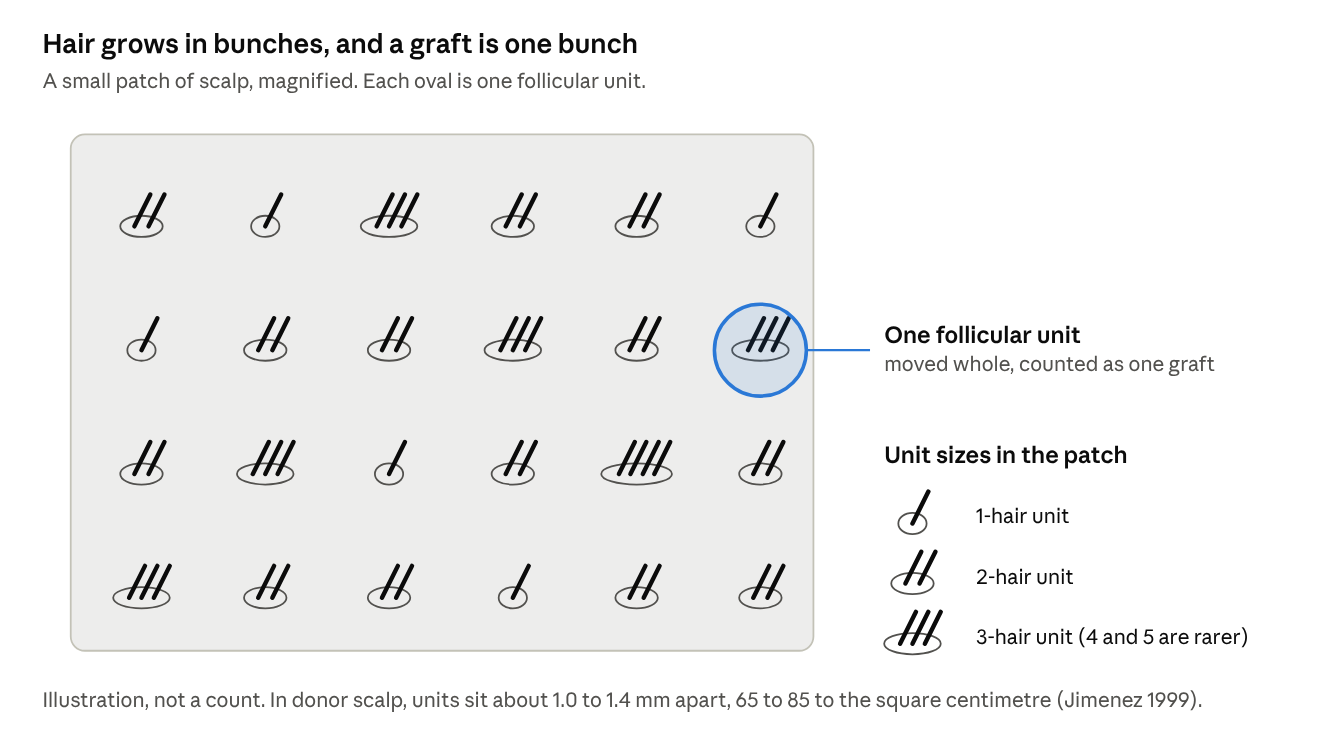
FUT removes a thin strip of scalp from the back of the head and divides it into follicular units under a microscope. Every unit inside the strip is used, and the scalp is closed to leave a single fine line [1]. FUE takes units one at a time through small round punches, leaving tiny dot scars spread across the donor.
Both methods produce good-quality grafts. They differ mainly in the scars they leave, and some patients suit one, some the other, and some both [2].
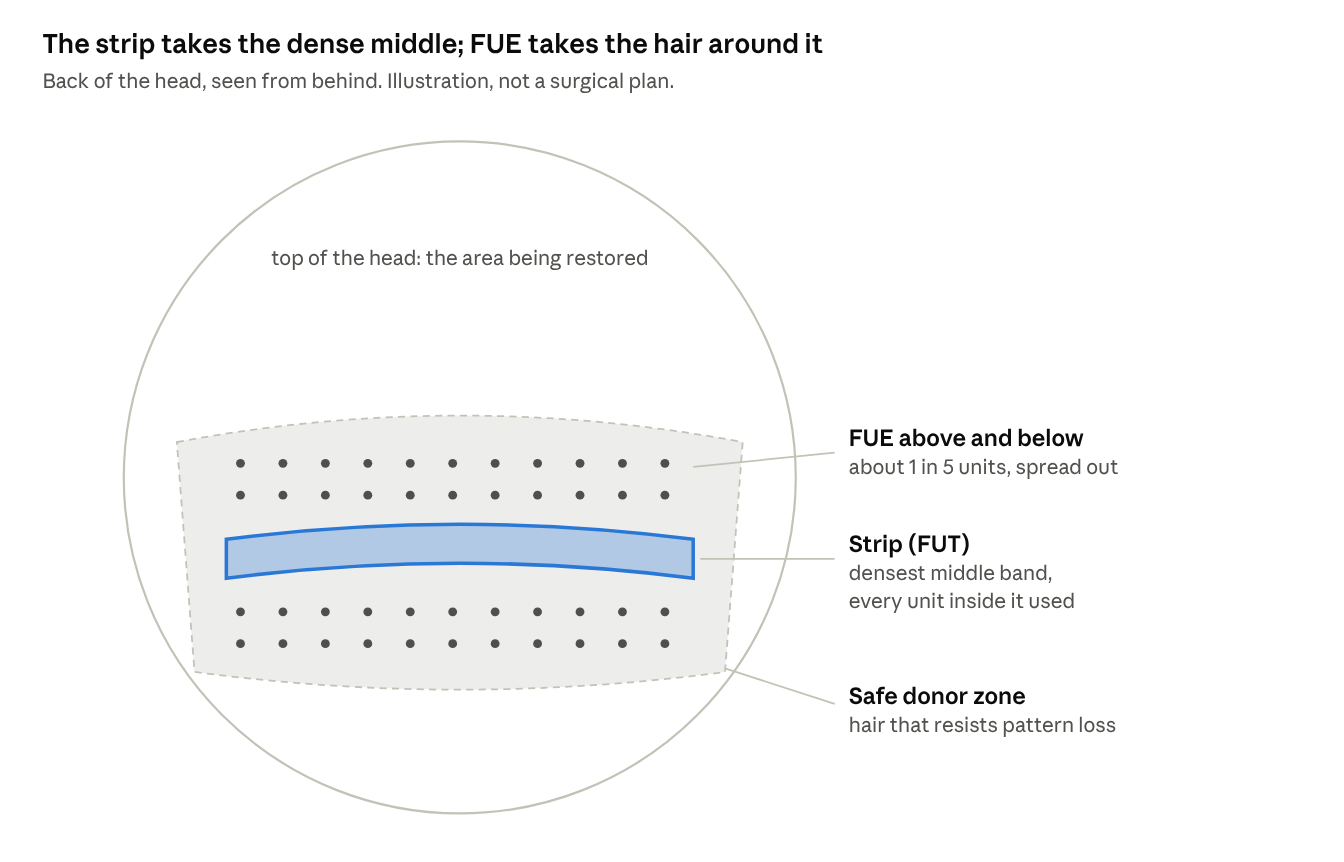
Combined FUT and FUE surgery is a plan that takes a strip from the densest middle of the donor area and FUE grafts from the hair around it, either in one session or in stages.
Why combine them
FUE can only take a share of the units in any area before it looks thin, roughly one in five [3]. A strip uses all of the units inside it, but it can only be as wide as the scalp will stretch to close [1]. Each method leaves hair the other can still reach.
The middle of the donor band is the best place for a strip. It is the densest part of the donor, and pattern loss advances above and below it, not through it [1]. The hair above and below the strip line is then thinned evenly with FUE.
Putting the two together gets more grafts from one lifetime of donor hair while lowering the risk of over-harvesting any one area [3, 4]. FUE is also the tool for softening an old strip scar later [3].
One day, or in stages
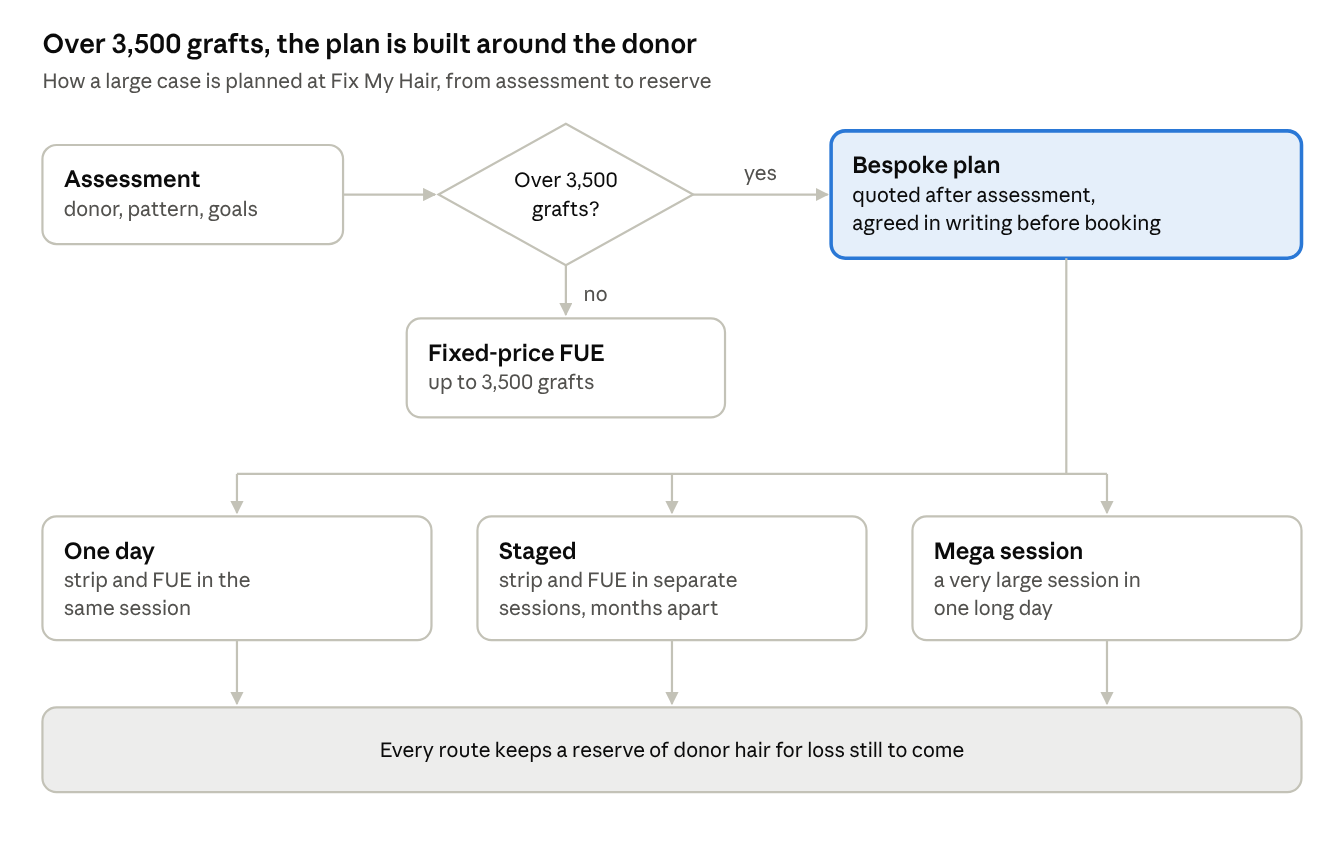
The two harvests can happen on the same day. One published approach takes the strip and then plans the FUE around it with a running count during surgery, so neither part over-harvests [5]. Another uses FUE punches to take the grafts inside a marked strip-shaped area, which removes the need for a large microscope dissection team [4].
They can also be staged, with the strip in one session and FUE months later, or the other way round. A repeat strip is usually not taken for 9 months to a year after the first [1].
Mega sessions: where they make sense, and where they don't
A mega session is a single, very large operation. There is no agreed cut-off, but a recent review treats sessions above about 3,500 to 4,000 grafts in this way [6]. In one series of 273 men with advanced hair loss, FUE mega sessions moved 3,000 to 6,000 units in 6 to 12 hours, and 19% went on to have a second procedure for more density [7].
They make sense when the hair loss is advanced and settled, the donor is dense, and the patient would rather have one long day than several shorter ones. They make less sense when the donor is thin, when the patient is young and the pattern is still moving, or when the number asked for is more than the donor can safely give. Large sessions carry more risk of complications such as folliculitis and poor healing at the recipient site, and donor over-harvesting is increasingly reported in sessions above 3,000 to 4,000 grafts [6].
How Fix My Hair prices large cases
FUE at Fix My Hair has three fixed prices, set by graft count and agreed in writing before booking.
| Grafts | Price |
|---|---|
| Up to 2,300 | £3,500 |
| 2,301 to 3,000 | £4,500 |
| 3,001 to 3,500 | £5,500 |
| Over 3,500 | Bespoke, planned as combined FUT and FUE surgery or a mega session |
Over 3,500 grafts, the price is bespoke, planned as combined FUT and FUE surgery or a mega session, quoted individually after your assessment and agreed in writing before you book. A fixed band would not fit, because the plan depends on how much your donor can give and how it is best taken.
Dr Hisham Band, the independent GMC-registered doctor who treats Fix My Hair patients, performs strip surgery (FUT) himself, as well as FUE, combined FUT and FUE surgery and mega sessions. Which of these suits you is decided at your assessment.
The picture, and where it breaks
Think of a lawn you need turf from. You can lift one long roll from the thickest middle, or take every fifth plug from all over. Do both, and you get more turf than either way alone while the lawn still looks green.
The picture breaks in three places. Turf does not have to stretch to close the gap, but scalp does, so the width of a strip is set by how loose the scalp is [1]. A lawn shows no line where the roll came from, but a strip leaves a scar that matters if you wear your hair very short. And turf does not suffer from waiting. Grafts do, which is why long sessions need careful storage, and why there are limits on how much can sensibly be done in one day [8].
What is actually happening
The strip is usually marked below the bump at the back of the skull, along the dense middle band, and can be 15 to 30 cm long depending on the size of the head [1]. It is dissected into intact follicular units under the microscope, the method that founded follicular unit transplantation [9].
FUE then works through the donor above and below the strip line. Most authors keep each FUE session to 10% to 20% of the units present, spread evenly and tapered at the edges, to avoid visible thinning [6].
In a long session grafts spend more time outside the body. In laboratory and clinical work for FUE mega sessions, follicles kept in cold Ringer's solution at 4°C for 8 hours survived as well as in standard surgery [8].
What this means if you are planning a transplant
- Over 3,500 grafts, expect a bespoke plan. The price follows the plan, not the other way round. Pricing shows the fixed bands and how larger cases are quoted.
- Ask what each method contributes. How many grafts from the strip, how many by FUE, and what scar to expect from each. FUE vs FUT vs DHI compares the methods.
- A bigger day is a bigger operation. More grafts means a longer procedure and a more demanding recovery. Hair transplant risks and downsides sets these out honestly.
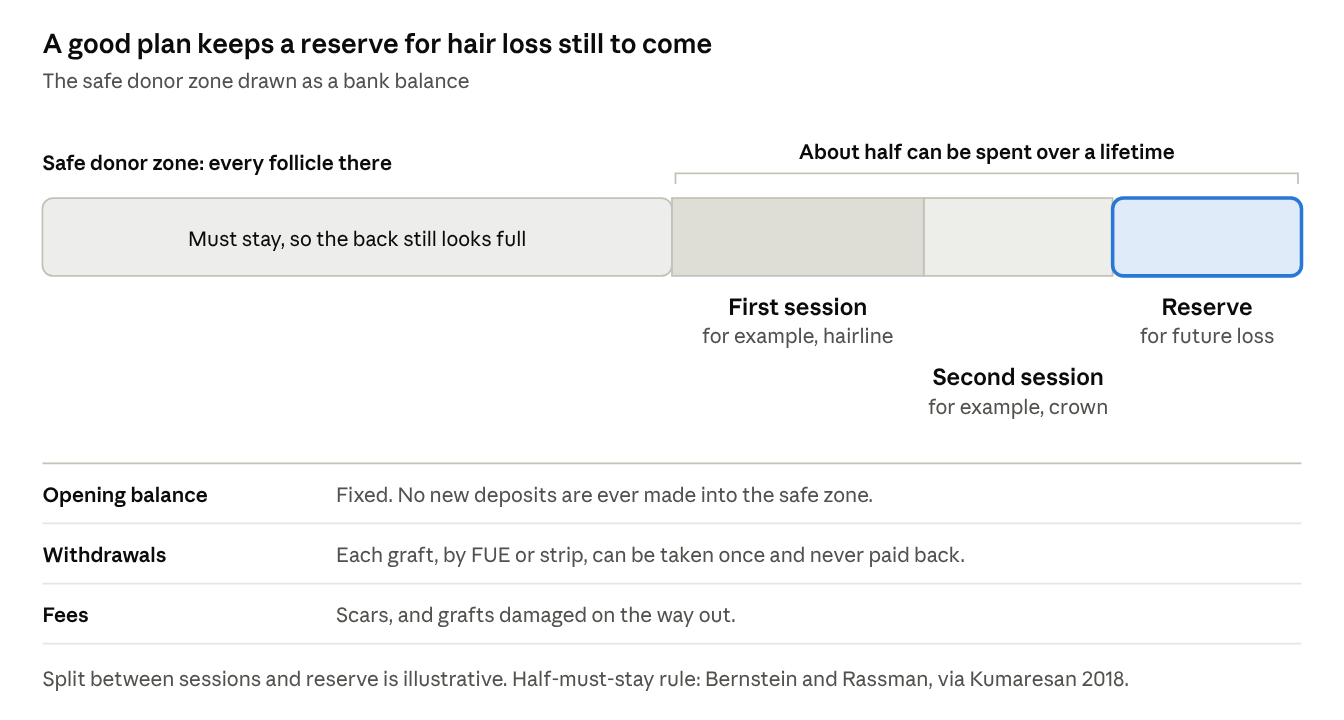
- Think in lifetimes. A plan that takes everything now leaves nothing for later loss. Your donor area is a bank account explains why.
For clinicians and technicians
- Take the strip from the mid-occipital band. It is the densest region and the source of permanent hair, with pattern loss progressing superior and inferior to it [1]. Mark below the occipital protuberance to avoid neck hair and muscle pull on the scar [1].
- Plan the combined harvest as one budget. Published methods include FUE dissection of the grafts inside a demarcated linear ellipse (FUE-LE) [4] and a sequential strip-then-FUE method with an intraoperative calculation to limit over-extraction and wastage [5].
- Stage repeat strips sensibly. Avoid a repeat strip before 9 months to a year, and remove the old scar with the new strip [1].
- Price the risks of size. Megasessions, dense packing and excessive tumescence are reported risk factors for recipient complications, and folliculitis risk rose in sessions over 4,000 grafts in one study cited by the review [6].
- Protect graft time. For long FUE sessions, 4°C Ringer's solution supported 8-hour storage with survival comparable to conventional surgery [8]. Keep dissection and placement teams in step so no tray waits.
- Select per patient. Distinct subgroups suit FUE, FUT or both [2]. Patients who refuse a linear scar, or wear their hair very short, may not suit the strip part of the plan [3].
Teach combined surgery as one donor budget with two tools. The question is never "FUT or FUE?" alone, but "how much can this donor give over a lifetime, and which tool takes each part of it best?"
Teach it back
If this article worked, you can now answer these without scrolling up.
- Why can a strip take more grafts from the area it covers than FUE can from the same area?
- Give one situation where a mega session is a poor idea.
- Why is a case over 3,500 grafts priced individually rather than in a fixed band?
References
- Khanna M. Hair transplant with strip harvest: indications, contraindications, and technique. Indian J Plast Surg. 2021;54(4):451-5. PubMed 34984084
- Gupta AK, Love RP, Harris JA. Old friend or new ally: a comparison of follicular unit transplantation and follicular unit excision methods in hair transplantation. Dermatol Surg. 2020;46(8):1078-83. PubMed 32141930
- Kumaresan M, Mysore V. Controversies in hair transplantation. J Cutan Aesthet Surg. 2018;11(4):173-81. PubMed 30886470
- Keene SA, Susacasa A, Miranda P, Radwanski H. Follicular unit excision-linear ellipse donor harvesting technique: combining standard follicular unit excision with follicular unit excision inside a linear strip (modified linear strip excision) to optimize graft yield. Facial Plast Surg. 2024;40(2):205-13. PubMed 37879352
- Krishnamurthy R, Jaganathan BK, Rangaswamy R, Jeganathan C. A novel method of intraoperative calculation in follicular unit transplantation: 'the sequential strip and FUE method'. Aesthetic Plast Surg. 2024;48(3):297-303. PubMed 36928376
- Romera de Blas C, Vega Díez D, Ricart Vayá JM, Gómez Zubiaur A. Complications in follicular unit excision hair transplantation: current evidence and practical approaches. Front Med (Lausanne). 2026;13:1750989. PubMed 41709896
- Li KT, Qu Q, Fan ZX, et al. Clinical experience on follicular unit extraction megasession for severe androgenetic alopecia. J Cosmet Dermatol. 2020;19(6):1481-6. PubMed 31529675
- Gan YY, Du LJ, Hong WJ, Hu ZQ, Miao Y. Theoretical basis and clinical practice for FUE megasession hair transplantation in the treatment of large area androgenic alopecia. J Cosmet Dermatol. 2021;20(1):210-7. PubMed 32346966
- Bernstein RM, Rassman WR. Follicular unit transplantation: 2005. Dermatol Clin. 2005;23(3):393-414. PubMed 16039422
Medical note: This article is general information, not medical advice. Whether a hair transplant or any treatment suits you is confirmed only at a consultation with a GMC-registered doctor. Results vary from person to person.