The eyebrow in three parts: head, body and tail
 Drafted by the Fix My Hair editorial team · Clinically reviewed by Dr Hisham Band · GMC No. 7550130 · Last reviewed 21 Oct 2026
In one breath: An eyebrow is not a strip of hair. It has three zones, each with hairs pointing a different way, and nearly all of them lie almost flat against the skin. A brow transplant looks natural when every graft is a single hair, set at the right angle and pointing the right way for its zone. Get that wrong and the brow looks stuck on.
Who has brow transplants, and why
The largest review of the published research gathered 67 studies covering 354 patients from 18 countries. Most patients were women, with an average age of 29. The commonest reason was not vanity at all: 57.6% had lost their brows to burns [1].
In clinic the reasons are wider. Brows over-plucked in the 1990s and 2000s that never came back. Scars from accidents, surgery or sport. Brows that were always sparse. And brows lost to medical conditions, which need a different conversation first (more on that below).
The picture: a field of wheat after the wind
Picture a field of wheat after a strong wind has blown across it from one side. Near where the wind started, the stalks are pushed up and over. In the middle, two gusts have met, so the stalks on each side lean towards a ridge. At the far end, everything has been flattened down and out.
A brow is like that field. The hairs near your nose point upwards, the hairs in the middle lean in towards each other, and the hairs at the outer end point down towards your ear.
The picture breaks in two places. Wheat stands up, but brow hair lies almost flat on the skin. And wheat grows in clumps, while brow hairs grow one at a time. Both of those details matter more to a surgeon than the direction does.
Head, body and tail
Look closely at a full, untouched brow and you can see three zones [2].
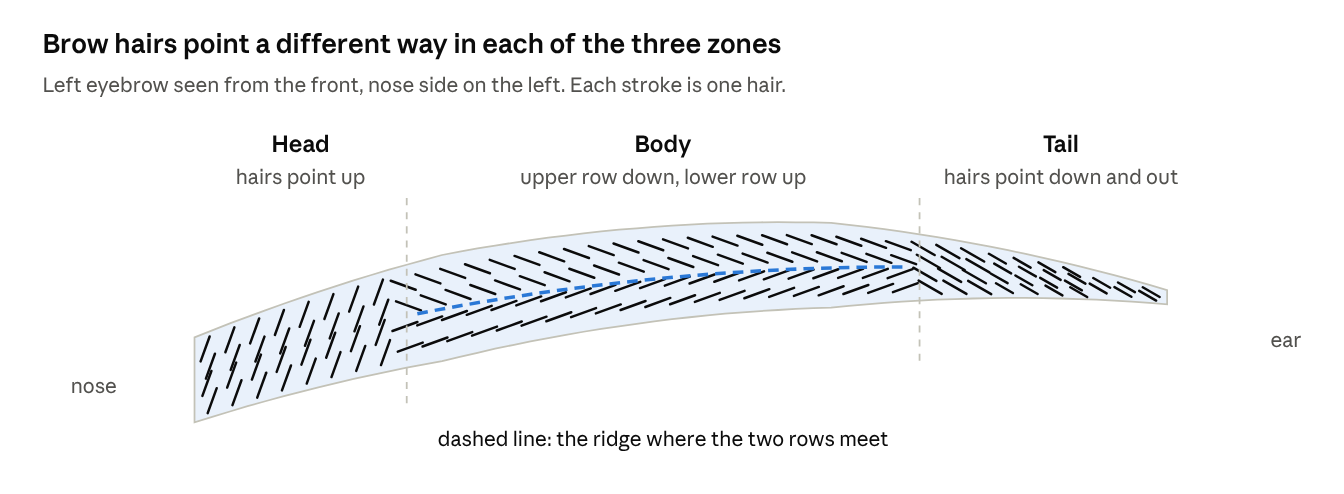
- The head, nearest the nose, has hairs that point upwards and slightly out. It is the softest part of the brow, with the fewest hairs.
- The body is the densest part. Hairs on its upper edge point down and out; hairs on its lower edge point up and out. They meet along a ridge, which is what gives a brow its shape and its slight shadow.
- The tail thins as it runs towards the ear, and its hairs point down and outwards.
This is why a transplanted brow can't be planted like a lawn. Each zone, and in the body each row, has its own direction.
Why one hair at a time, and the angle problem
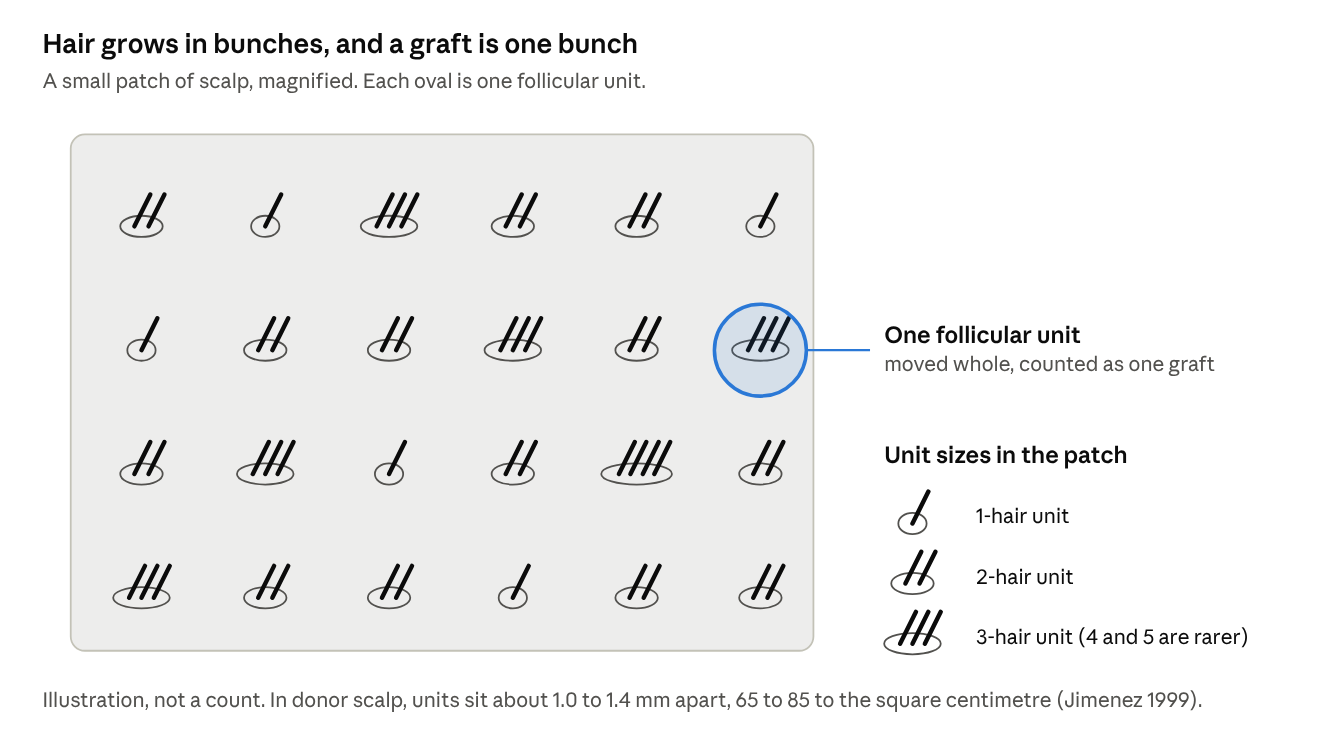
On the scalp, hair grows in natural groups of one to four, and a transplant moves those groups whole (follicular units). Brow hairs grow one by one. A two-hair graft at the head or the tail of a brow looks like a little tuft, so the careful approach is single-hair grafts, at least at the edges [1, 3].
The second problem is the angle. Scalp hair leaves the skin at a slope you can see. Brow hair lies almost along the skin.
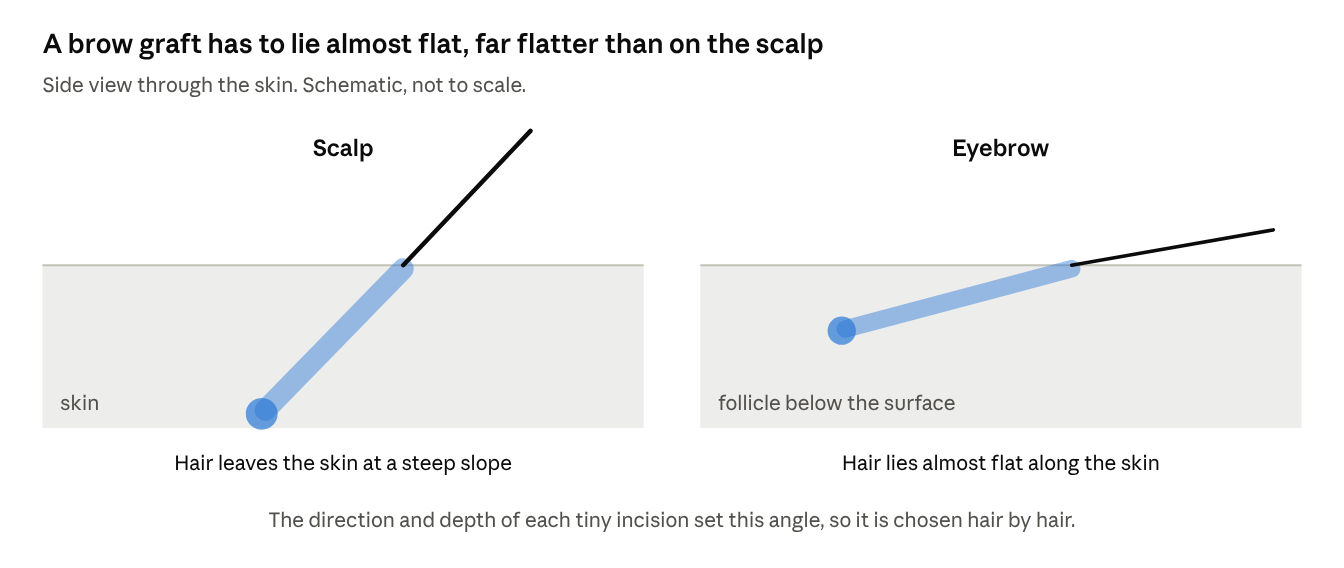
The surgeon controls this through the tiny incision each graft sits in: its direction, its depth and how flat it is cut. That is slow, careful work, and it is most of what separates a natural brow from a stuck-on one.
Mapping the brow to your face
Before any graft goes in, the brow is drawn on. Brow artists and surgeons often start with three lines from the side of the nose.
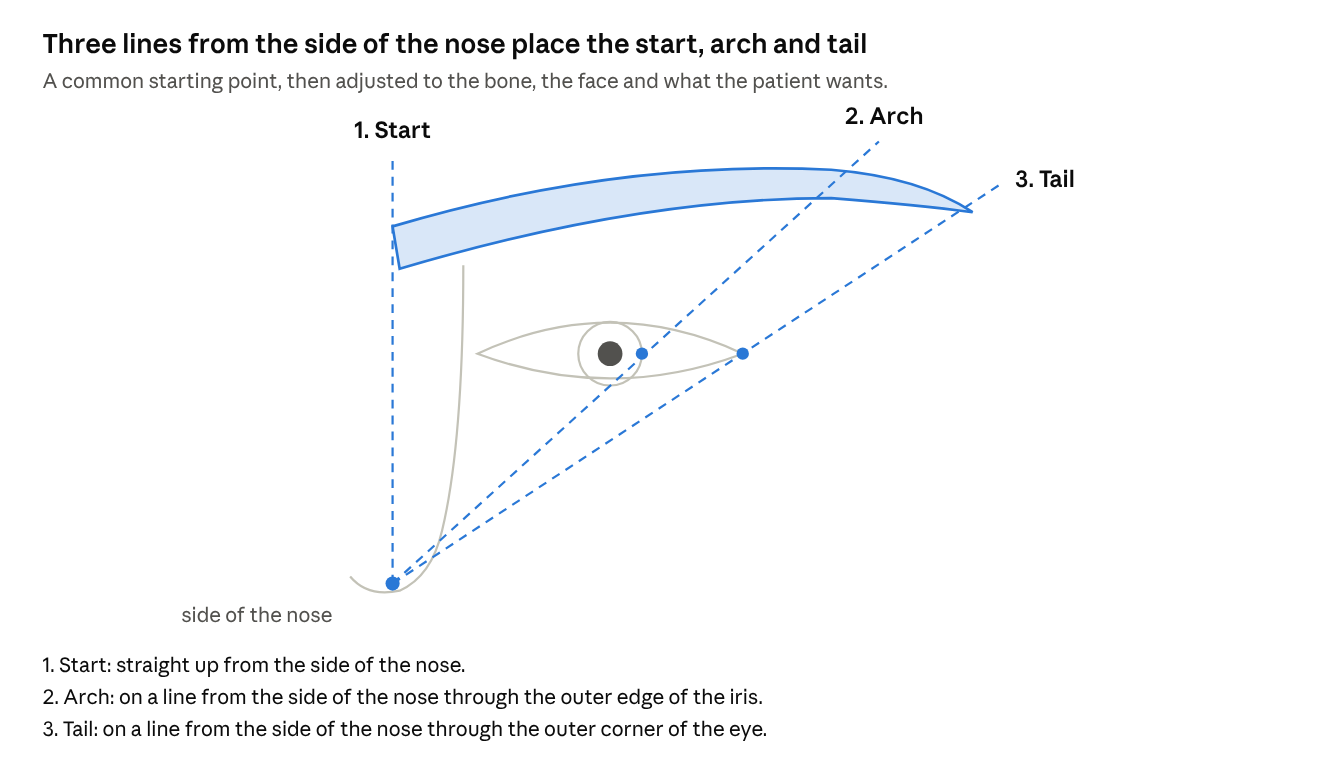
Those lines are a starting point, not a rule. The brow bone, the space between the eyes, age and personal taste all move the final shape. A good consultation includes time with a mirror and a pencil until you recognise yourself in the drawing. Fashion changes, too, which is one more reason to favour a natural, slightly conservative brow over this year's trend.
Borrowed hair keeps its habits
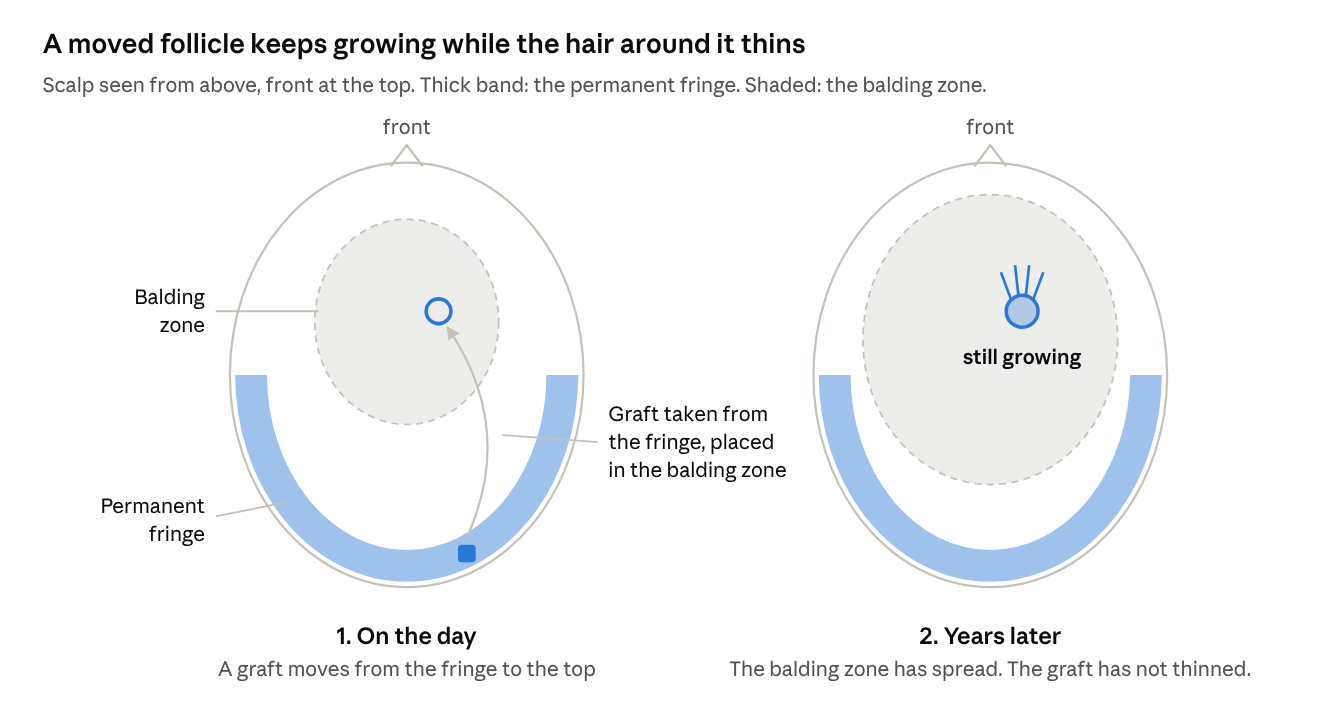
There is no spare eyebrow hair to move, so the grafts usually come from the scalp, most often from the back of the head or the hairline at the nape of the neck [1]. As our article on why the back of your head never goes bald explains, a moved hair keeps most of its old habits.
Scalp hair grows faster and longer than brow hair, so transplanted brows need trimming for life [1]. In the case reports in the review, the gap between trims ranged from every two to three weeks to every five to six weeks, depending on where the donor hair came from [1]. Most people find it takes a minute with small scissors and a brow comb. It is still worth knowing before you start.
A useful side effect: because the hairs keep growing, you can leave them a little longer and shape them with gel, which brow artists can work with.
The medical check before any brow is planned
Sometimes brow loss is the first visible sign of something else. A brow transplant placed into an active condition can fail, so the cause comes first.
- Frontal fibrosing alopecia. A scarring hair loss that mainly affects women after the menopause. Brow loss is very common in it: in a UK study of 711 women with the condition, it was one of the defining features [4]. In some patients the brows go before the hairline does [5].
- An underactive thyroid. Thinning of the outer third of the brow is a long-described sign, sometimes called Hertoghe's sign [6].
- Alopecia areata, which can come and go, and hair-pulling, which needs support rather than surgery.
If your brows thinned in later life, or are still thinning, expect your surgeon to examine them closely and possibly ask for blood tests or a dermatologist's opinion first. That is not a delay for its own sake. It is what stops a transplant from failing.
What recovery looks like
The procedure is done under local anaesthetic. Small crusts form around each graft and fall away over the first week or so. Swelling and bruising around the eyes can happen and usually settle on their own [1].
Then comes the part that worries people. Most transplanted hairs shed in the first few weeks. The follicle is still alive under the skin; it is resting, not lost. New growth usually shows from around the third month, and the brow keeps filling in through the first year. Our month-by-month recovery guide explains the same cycle for scalp transplants, and eyebrow transplants for Nottingham patients sets out how the service works.
For clinicians and technicians
- Single-hair grafts at the head and tail are not optional. Two-hair units read as tufts at conversation distance. Some surgeons accept two-hair units in the body of the brow [1]; others use singles throughout [3]. Sort grafts by hair count at the bench and keep the singles for the edges.
- Make the site match the hair. The direction and depth of the recipient incision decide the hair's exit angle. Flat incisions, oriented zone by zone, and shallow enough that the graft does not sit proud. Published technique papers stress angle and direction as decisive for the result [2, 3]. We have not quoted a figure in degrees: surgeons describe different numbers, and the angle that matters is the one that matches the patient's surviving hairs.
- Read the patient's own brow first. Where native hairs survive, they show the direction to copy. Mark it before anaesthetic, because swelling changes the skin.
- Upper and lower rows converge. In the body, the upper row points down and out and the lower row up and out, so they meet in a ridge [2]. A brow planted in one direction looks combed flat and unnatural.
- Graft numbers stay small. Rajput's review puts a typical aesthetic reconstruction at about 70 to 120 grafts [3]. Density is built by angle and direction more than by numbers.
- Screen for scarring alopecia. Dermoscopy of the brow and the frontal hairline before any plan, in every patient with acquired brow loss [4, 5].
- Microblading and tattoo pigment in the brow change both mapping and photography. Record it at consultation and photograph in the same light at every visit.
Teach it back
- Which way do the hairs point in each of the three parts of the brow?
- Why are eyebrow grafts single hairs, when scalp grafts often hold two or three?
- Why do transplanted brows need trimming, and why might a surgeon ask for blood tests before planning one?
References
- Klingbeil KD, Fertig R. Eyebrow and eyelash hair transplantation: a systematic review. J Clin Aesthet Dermatol. 2018;11(6):21-30. PubMed 29942421
- Laorwong K, Pathomvanich D, Bunagan K. Eyebrow transplantation in Asians. Dermatol Surg. 2009;35(3):496-503. PubMed 19292838
- Rajput RJ. Hair transplant for eyebrow restoration. Indian J Plast Surg. 2021;54(4):489-94. PubMed 34984090
- McSweeney SM, Christou EAA, Dand N, et al. Frontal fibrosing alopecia: a descriptive cross-sectional study of 711 cases in female patients from the UK. Br J Dermatol. 2020;183(6):1136-8. PubMed 32652611
- Starace M, Brandi N, Alessandrini A, Bruni F, Piraccini BM. Frontal fibrosing alopecia: a case series of 65 patients seen in a single Italian centre. J Eur Acad Dermatol Venereol. 2019;33(2):433-8. PubMed 30472804
- Tekiner H, Yale ES, Yale SH. Removing the name Queen Anne sign from the medical literature. CMAJ letter, 24 Feb 2022. cmaj.ca
Medical note: This article is general information, not medical advice. Whether a hair transplant or any treatment suits you is confirmed only at a consultation with a GMC-registered doctor. Results vary from person to person.